Robin

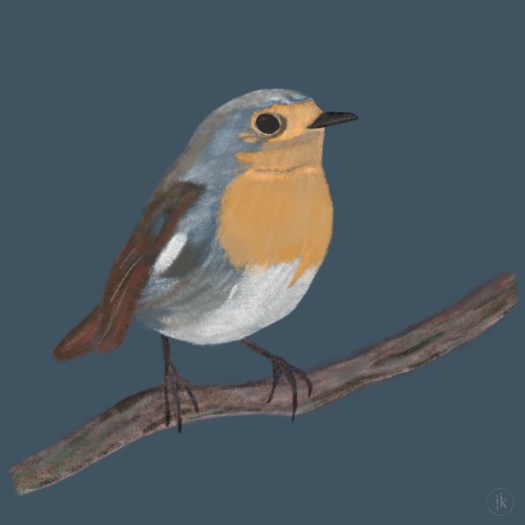
I love this bird. The robin has beautiful colours. Its orange is dazzling. It lives with wife and children (temporary) in our garden. Companions at home. This summer, the family was part of our household. So far from my perspective and my charcoal pencils.

The present news about dictators, autocrats (on all levels) and democratic power houses brings me to another dimension of this bird. It is of course a personal association, in moments becoming a metaphor.

From ecological point of view the robin is relevant in the food chain. Itself it is a fierceless predator of insects and worms. Hm. Defends its territory with all its focus and effort. It does all what is necessary for that.

I recognise this behaviour in the world of power and influence (as Machiavelli described the world of ‘politics’), reading through today’s headlines – in all sizes, forms and capacities.

What helps in my idea, is the fact that the robin (and with all associations attached) is eaten by owls (wisest of all), buzzards (honest birds), hawks (masters of the wood) and falcons (actors of balance). The circle of life is hard but gives hope. I still love this bird.

Bibliography

Kruf, J.P. (2022) Robin [fine art print]. Breda: private collection.

Storm

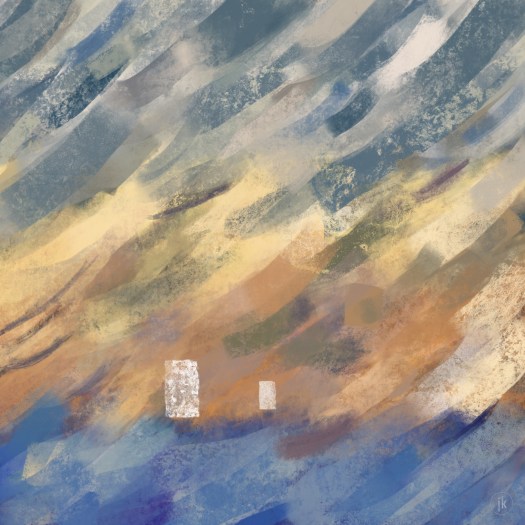
© Jack Kruf. (2022) Storm. [fine are print, 1/1]. Breda: Private collection.

There is this feeling a storm is coming and all elements – water, earth, fire and air – will be tested. A personal art expression reading today’s headlines about war, climate change, diversity loss, right wing regimes, loss of democracy and human rights, the lust for and use of power, poverty, pollution and above all incompetent leadership. We seem to be frozen, and paralysed to act swiftly and accurately. What to say, what to feel? Words, I can not find. Paint helps.

The forest for the trees?

To find the forest for the trees can be challenging for a simple human being like me. The emerging of crises in all sorts and dimensions should implicate an expected swift and adequate action, at least from government. I see though a parcelled landscape of initiatives and actions, not that effective or even missing focus and target.

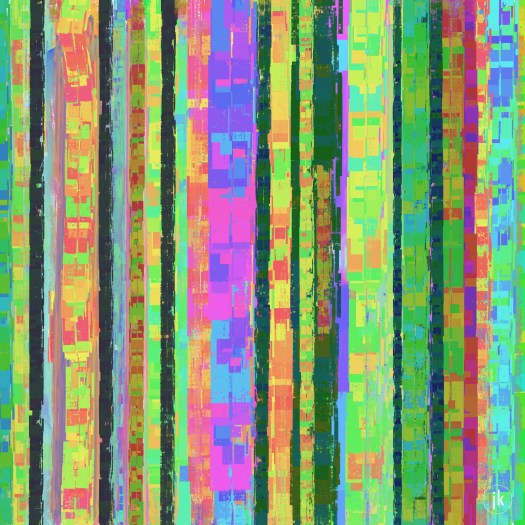
I find myself in a forest with trees all over the place, given me a kaleidoscopic colour palette but no sense where I am and no direction where to go. I try to see the forest for the trees. A personal art impression.

Bibliography

Kruf, J.P. (2022) The forest for the trees? [fine are print]. Breda, The Netherlands: Private collection.

View on Delft

Vermeer, Johannes (1660-1661) View on Delft [oil on canvas]. The Hague: Mauritshuis.
This painting of the city of Delft made around 1660, is from the master hand of Johannes Vermeer. More than inspiring. A place to live. Around 360 years back in time. With View of Delft, Vermeer created an iconic image of the city: the city as an entity, the city as an ecosystem.The overarching cloudy sky gives the city the insight and dimension that it is part of a larger world, maybe that of nature. It puts Delft in perspective. It humbles. At the same time, the citizens in the foreground remind you as a watcher that the painting is also about everyday life. It sketches the city itself as comprehensive and offering a higher dimension to its inhabitants. That of a place where you may belong, where you can live, love, meet and work.View on Delft is a holistic image in which Vermeer shows us the multiple layers of the ecosystem ‘city’: citizen, group, street, neighbourhood and city. In ecological terms, he shows organisms, groups, niches, habitats and systems at the same time. And that under the clouds of a much larger dimension, the sky, the world. A masterpiece.

An interesting analysis by Christopher Volpe: “Marcel Proust thought View of Delft by Vermeer the most beautiful picture in the world. It’s been called a perfect painting, and whether or not you agree, the artist’s picture of his hometown assuredly does repay close looking.” Read more

De expressiekracht van Wasilly Kandinsky

Het publieke domein kan worden beschouwd als het stedelijk canvas dat plaats biedt aan een samenspel van burgers, bedrijven, maatschappelijke organisaties, overheden en de omringende omgeving. Of ook als de dynamiek van rijk geschakeerde beelden en geluiden. 

De dynamiek van het publieke domein zou in ‘Composition VIII’ door Wassily Kandinsky in 1923 tot leven kunnen zijn gebracht. Hij was er in zijn wezen op gericht een abstracte taal te ontwikkelen die sterke emoties kon oproepen net zoals de muziek dat kon doen: “Form itself, even if completely abstract … has its own inner sound,” schreef hij.

Wasilly Kandinsky

Kandinsky was op zoek naar een universele harmonieleer in de visuele kunsten, dat aan de basis van elk werk zou moeten liggen. Een haast mystiek geloof dat werd versterkt door overtuigende innerlijke kracht van de schilder: “Color is the keyboard, the eyes are the hammers, the soul is the piano with many strings. The artist is the hand that plays, touching one key or another purposely, to cause vibrations in the soul.” (Kandinsky in Thornwillow republication)

Kandinsky, V. (2013) Effect of Color. Newburgh, NY: Thornwillow Press. A republication of Kandinsky, V. (1911) Concerning the Spiritual in Art.