
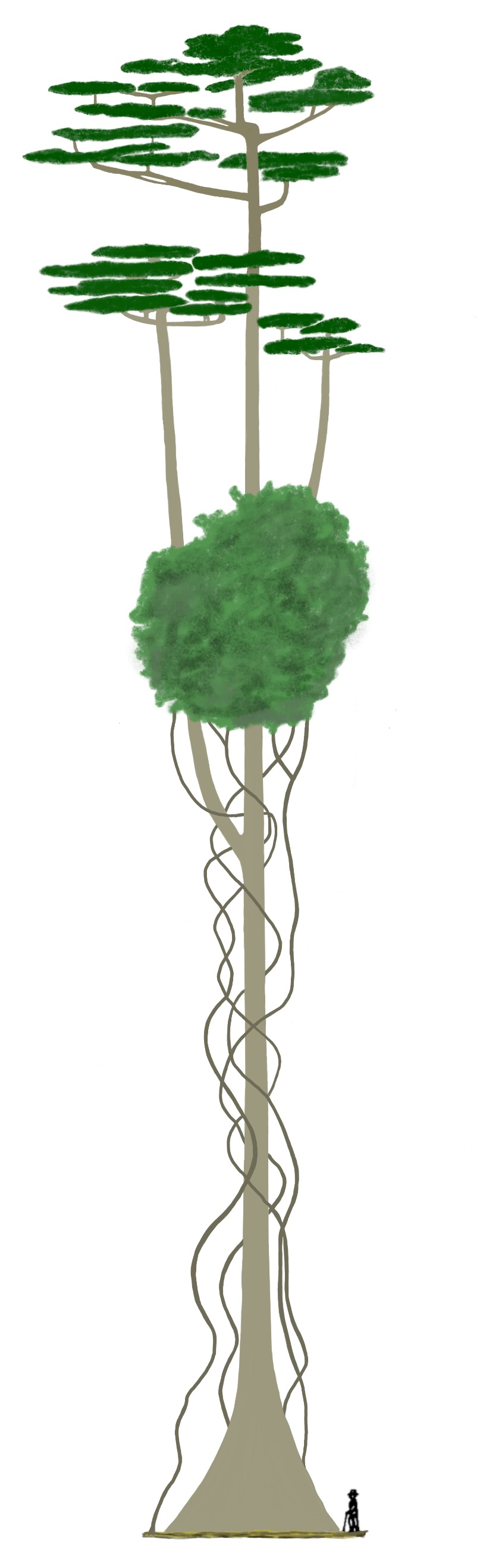
 One of the core determinants in diagnosing an ecosystem is the interaction between components.
Understanding the exact interaction—or, in this case, a combination of interactions—is key to proper diagnosis.
This design tells the story of a tree and a liane. Who benefits from whom, when, and why? The tree and liane are real, as measured by Roelof Oldeman (1974a), but they are also metaphors for people or organisations.
I firmly believe in the plausibility of this substitution, primarily due to the universal nature of ecological interactions. These are governed by a set of fundamental patterns, a mere seven, which exist in nature. This universality extends to the public domain, which is intricately intertwined with nature.
It is part of transect by Oldeman (1974a): “La liane perchée sur le Terminalia amazonia à une hauteur d’environ 35 mètres appartient probablement à la famille des Polygonacées“. Curation and colour selection by Jack Kruf.
Bibliography
Oldeman, R.A.A. (1974a, 2nd ed.). L’architecture de la forêt guyanaise. Mémoires ORSTOM, 73.
 Kruf Huyssons