Climate Book

We still have time to change the world. From Greta Thunberg, the world’s leading climate activist, comes the essential handbook for making it happen. It is published by Allen Lane, Penguin Random House.

You might think it’s an impossible task: secure a safe future for life on Earth, at a scale and speed never seen, against all the odds. There is hope – but only if we listen to the science before it’s too late.

In The Climate Book, Greta Thunberg has gathered the wisdom of over one hundred experts – geophysicists, oceanographers and meteorologists; engineers, economists and mathematicians; historians, philosophers and indigenous leaders – to equip us all with the knowledge we need to combat climate disaster.

The crisis cannot be addressed, she writes, without talking about ‘morality, justice, shame, responsibility and guilt’

Alongside them, she shares her own stories of demonstrating and uncovering greenwashing around the world, revealing how much we have been kept in the dark. This is one of our biggest challenges, she shows, but also our greatest source of hope. Once we are given the full picture, how can we not act? And if a schoolchild’s strike could ignite a global protest, what could we do collectively if we tried?

We are alive at the most decisive time in the history of humanity. Together, we can do the seemingly impossible. But it has to be us, and it has to be now.

“One phrase from entomologist Dave Goulson seems to summarise all 464 pages: “It is not quite too late.” Emphasis on the quite.”

The last quote is from the Professor of Biology at University of Sussex, specializing in bee ecology, in the essay The Climate Book, created by Greta Thunberg review – an angry call for action by  for the Guardian.

My Word

Jack Kruf

This matrix links the internal and external drive to that of the language domain. It is often used in communication within politics and government. Of course, it also applies to the private and business worlds and the personal domains. Our words often share a light behind the scenes. This diagram brings drives and words together.

Bron: De Graaf en Kunst (2009). Design My Word (2020) ©Jack Kruf

The maximum of both worlds is want, and if the external drive is higher than the internal must is used, vice versa that is may. If both are low then can is used. In the middle of the matrix, the word dare is positioned to cross over or break through the boundaries of a quadrant. The matrix is often used in communication, co-creation and design sessions within groups.

The spoken language can tell us a lot about the internal drive of those who use the word in relation to the need to act. Many present policy plans use the word must. The context here is the need for change, innovation, development, transition, and transformation related to climate, energy, water, cyber, circular, social care, finance, resilience, and ecosystem protection. Migrating to want would give a lot of power. Is this possible, maybe seduction and education?

My word can be considered as an indicator of where I am in the diagram. From there, navigation can start.

Bibliography

Graaf, A. de en Kunst, K. (2009) Einstein en de kunst van het zeilen: Praktijkboek over leiderschap en communicatie. Amsterdam: Uitgeverij SWP. link

Forest Biometrics

I designed an intelligent pawn, called Equoi. It is in essence a simple concept, like that of the barometer or thermometer. It measures the mood of an object, place or process. The pawn is virtually full of sensors. Its application is easy: just put it on the table, ask your question, wait a moment and Equoi tells you the how and the what.

© Jack Kruf (2019) Forest Biometrics [3d-print]. Breda: Private collection
Here the global state of the forests is measured. What emerges is a result with a highly fragmented pattern. Indeed most of the forests are reduced, exploited, intersected. Deforestation has done its work and continues to do so. The left islands of forest, sometimes no more than ‘a group of trees’, are almost too small to survive as an ecosystem.

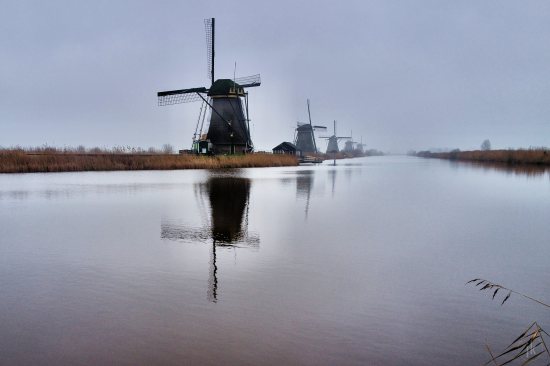
Kinderdijk Mills

© Jack Kruf (2021) Kinderdijk Mills [fine art print]. Breda: Private collection.

The mills at Kinderdijk on a cloudy winter day. These impressive artefacts show themselves as well as their reflections in this grey and misty landscape. This is an UNESCO World Heritage site at the Alblasserwaard, one of the oldest polders in The Netherlands.

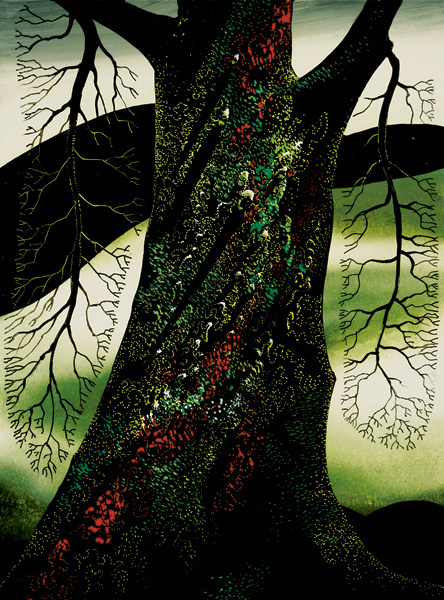
The Art of Eyvind Earle

Eyvind Earl is one of those artists who studied nature and its morphogenetic appearance, especially trees. He developed his craftsmanship to a high level art expression, making it to a true ode to nature. His works are of a level, that the strong desire emerges to want to live in the world he painted.

Oak Tree Serigraph © Eyvind Earl