Alleen op de wereld

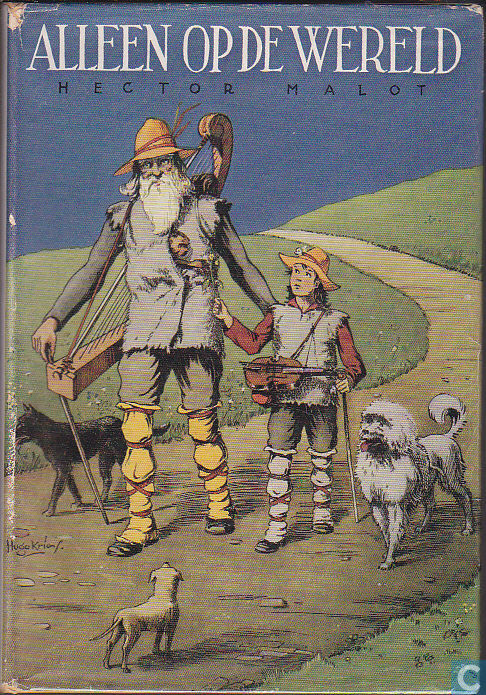
Het boek Alleen op de wereld werd voor het eerst gepubliceerd in 1878. Het verhaal gaat over de vondeling Rémi en zijn zoektocht naar zijn afkomst. Met een reizende artiest, de Italiaan Vitalis, en zijn dieren trekt hij de wereld in. Het boekt vertelt het verhaal van een samenleving die in beweging is, net als nu.

Cover 1962, © Uitgeverij V.A. Kramers

De Franse schrijver Hector Malot neemt ons mee naar een Europa dat volop in ontwikkeling is en de eerste stappen zet naar een moderne economie. Naar ook een Europa waar nog veel armoede is en het leven aan de zelfkant een gevecht op zichzelf blijkt te zijn. Ook een Europa, dat nog landelijk is, waar wolven nog vrij rondlopen. Een Europa dat nog niet is geïndustrialiseerd, maar duidelijk de eerste stappen in die richting zet.

Op zijn omzwervingen ontmoet hij allerlei type mensen. Hij leert over vertrouwen, uitbuiting, misbruik en ontmoet de kracht van vriendelijkheid en eerlijkheid.

Het boek is de ‘bijbel’ van de samenleving. Het is zeer actueel, veel patronen zijn vergelijkbaar met het heden. Een must read. Het is fascinerend te lezen hoe weinig er in 144 jaar veranderd is.

Door Palette

© Jack Kruf (2021) Door Palette [fine art print]. Breda: Private collection.

A bus stop actually can deliver a surprising palette of colours and materials. Here in the city of Breda (my city). Great design: wood, polyester and metal form this unique combination. The light brown, gray and silver palette is clean, neat and organised. It is interacting with the evening light.

Trees

This elegant collection of Hermann Hesse’s essays, poems, and passages on trees, accompanied by thirty-two of his hand-painted watercolor illustrations, reveals his sacred understanding of trees as symbols of transcendence and rebirth, of instinctive growth present in all natural life.

It is published by Kales Press, selected by Volker Michels* and translated from the German by Damion Searls**.

Trees mirrors landscapes as Hesse experienced them, both artistically and spiritually, and reminds us that the life of a tree is also a metaphor for our own life of perseverance, happiness, and purpose. In the author’s words:

“They struggle with all the force of their lives for one thing only: to fulfill themselves according to their own laws . . . Whoever has learned to listen to trees no longer wants to be one. He wants to be nothing except who he is.”

Bibliography

Hesse, H. (2022) Trees: An anthology of writings and paintings. San Diego, California: Kales Press.

*Volker Michels, the world’s foremost authority on Hermann Hesse’s work, manages the Nobel laureate’s literary and artistic estate.

**Damion Searls (personal website) is the translator of more than fifty books, including Hermann Hesse’s Demian, and the recipient of numerous awards.

Picture above is part of Hermann Hesse, Early Spring, 1925.

Recommended

The Day Hermann Hesse Discovered the Meaning of Life in a Tree

Path

After the loss of a dear friend some weeks ago, I imagined with my pencils this path for him. A stairway in a pristine white setting under an azure blue sky.A path to heaven, there he will arrive soon. He has all the love, care and involvement certificates to be accepted. Of that I am sure. A path to eternity it will be.

He already did pass the gate. I look upwards to it and see the blue sky. He is gone. I knew him. He was my friend. He is within the heart, within the soul.

Bibliography

Kruf, J.P. (2022) Path [fine art print]. Breda, The Netherlands: Private collection.

Robin

I love this bird. The robin has beautiful colours. Its orange is dazzling. It lives with wife and children (temporary) in our garden. Companions at home. This summer, the family was part of our household. So far from my perspective and my charcoal pencils.

The present news about dictators, autocrats (on all levels) and democratic power houses brings me to another dimension of this bird. It is of course a personal association, in moments becoming a metaphor.

From ecological point of view the robin is relevant in the food chain. Itself it is a fierceless predator of insects and worms. Hm. Defends its territory with all its focus and effort. It does all what is necessary for that.

I recognise this behaviour in the world of power and influence (as Machiavelli described the world of ‘politics’), reading through today’s headlines – in all sizes, forms and capacities.

What helps in my idea, is the fact that the robin (and with all associations attached) is eaten by owls (wisest of all), buzzards (honest birds), hawks (masters of the wood) and falcons (actors of balance). The circle of life is hard but gives hope. I still love this bird.

Bibliography

Kruf, J.P. (2022) Robin [fine art print]. Breda: private collection.