One of the crucial skills of public leaders and managers is to be able to get the bigger picture of society and, from there, to connect things and act accordingly. Mayors and city managers, among others, must focus on the bigger picture, while aldermen and directors have their specific discipline, craftsmanship and portfolio. Overview and content go hand in hand, both complementary pieces of the puzzle of public governance. Zooming out is a form of art necessary to understand the city as an ecosystem. For this art, Alexander von Humboldt and Roelof A.A. Oldeman have been of great inspiration. They say the ability to zoom out is essential for true knowledge. Two quotes.
Naturalist, explorer and geographer Alexander von Humboldt (1856) concluded that zooming out leads to more overview and allows interconnecting things (and even sciences). Von Humboldt gave guidance on the relationship between ecosystems and abiotic factors. He came to this fascinating conclusion in Cosmos, actually revolutionary for that time.
“Physical geography…, elevated to a higher point of view, … embraces the sphere of organic life…”. – Von Humboldt (1856).
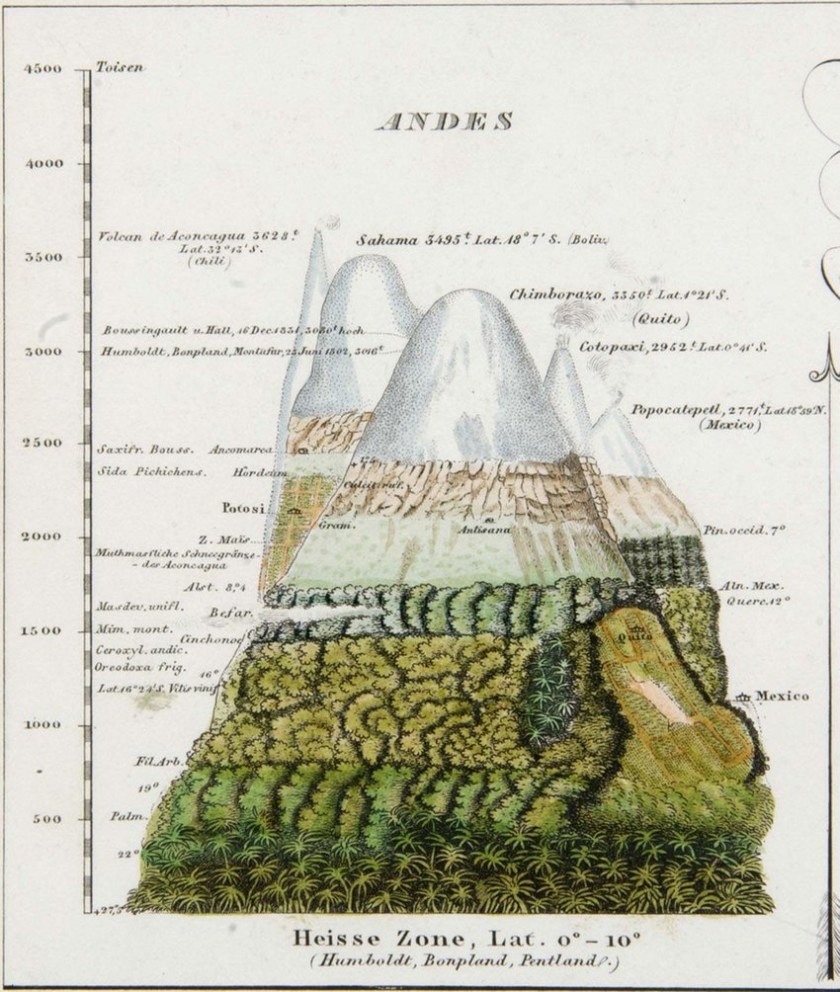
The atlas by Berghaus (1945) gives more insight into the range and character of connections. This atlas was used to illustrate Alexander von Humboldt’s Cosmos. The latest saw the connection between life in the ecosystems and soil, water, energy and climate constraints. Nobody before him had done this. Also, in cities, these connections between in fact habitats and communities are all over the place. So we can learn here from the discoveries of Von Humboldt.
“The principle impulse by which I was directed was the earnest endeavour to comprehend the phenomena of physical objects in their general connection, and to represent nature as one great whole, moved and animated by internal forces. Without an earnest striving to attain to a knowledge of special branches of study, all attempts to give a grand and general view of the universe would be nothing more than vain illusion.” – Von Humboldt (1856)
The connection between sciences seems to be necessary to find the real answers. It is about sharpening one’s view from different angles and principles. Oldeman et al. (1990) underlined the need for such a holistic approach to diagnosis in cross-border studies of forests. He always encouraged the necessity to cross the universities and faculties so heavily guarded boundaries within the fragmented landscape of sciences. For most of the city challenges, the process of policymaking and service delivery must be based on a cross-border view to come to well-founded decisions.
“The group that was responsible for the forest components theme decided to accelerate the process by starting an ambitious project, the writing of a common book. There is no way in which cooperation can be stimulated better, but this way has to be learned and practised too. The result is now before you. The book is not yet ideal in our opinion because it still contains too many traces of the old University tradition of researchers working, each apart, on such narrow subjects as they know best.
Von Humboldt and Oldeman are inspiring in this cross-scientific and pluridisciplinary discovery. Zooming out is crucial to get the picture. For finding the tone a systematic process of zooming in and out is necessary. Proper and sharp observation is in the heart of this all.
Bibliography
Berghaus, H. (1945) Physikalischer Atlas. Gotha: Verlag von Justus Perthes.
Buttimer, A. (2012) Alexander von Humboldt and planet Earth’s green mantle. European Journal of Geography. https://cybergeo.revues.org/25478
Humboldt, Alexander von (1856) Cosmos: A Sketch of a Physical Description of the Universe, Volume 1. New York: Harper & Brothers Publishers. 406 pp.
Oldeman, R., Schmidt, P. and Arnolds, E. (1990) Forest components. Wageningen: Aricultural University, 111 pp.


 Kruf Huyssons