The confirmation bias in us

Jack Kruf

Some things are remarkable and for most leaders and managers hidden or simply unnoticed. One of them is confirmation bias. Within science and literature, it is described, researched and elaborated over and over again, throughout history in fact, beginning with the Greek historian Thucydides (Dent, 1910). He wrote:

… for it is a habit of mankind to entrust to careless hope what they long for, and to use sovereign reason to thrust aside what they do not fancy.”  

The definition of Haselton et al. (2005): a systematic pattern of deviation from norm or rationality in judgment. It ads to this the interpretation:

Individuals create their own “subjective reality” from their perception of the input. An individual’s construction of reality, not the objective input, may dictate their behavior in the world. Thus, cognitive biases may sometimes lead to perceptual distortion, inaccurate judgment, illogical interpretation, or what is broadly called irrationality.

Generally spoken we, humans, have some ’embedded heuristics’ which Daniel Kahneman and Amos Tversky described as ‘highly economical and usually effective but lead to systematic and predictable errors’. It is an aspect to be aware of when chairing or participating in a meeting. It is mentioned as a key driver in risk management theories. It can creep into the discussion and decision making process, staying unnoticed and dressed as humor, good-spirit, support, collegiality and optimism.

This steering mechanism in our brains can be defined according to Cambridge Dictionary “as the way a particular person understands events, facts, and other people, which is based on their own particular set of beliefs and experiences and may not be reasonable or accurate.”

Confirmation bias is also about the internal “yes man“, echoing back a person’s beliefs like Charles Dickens‘ character Uriah Heep in his book David Copperfield. Uriah, the clerk is “cloying humility, obsequiousness, and insincerity, making frequent references to his own ‘humbleness’” (Wikipedia).

In a short but excellent video Jason Zweig (2009) explains how this mechanism is related to the handling of our own stocks and investments, this in addition to his article. Confirmation bias is all over the place in the stock-market. It is studied extensively. Zweig gives advice on how to ignore the yes-man in our heads.

Social psychologist Richard Stanley Crutchfield discovered that 1/3 of the people ignored what they saw and went with the consensus. People within a research experiment (and this has been done over and over again) al agreed on a certain question when they were not exposed to the answers of others. But when they heard that every one of their group disagreed (before they gave their judgment), 31 to 37 percent said they did not agree!

Solomon Asch (Gardner, 2009) also concluded later in new experiments,  that “overall, people conformed to an obviously false group consensus one-third of the time”. Inline with what Crutchfield discovered earlier. Gardner concludes:“We are social animals and what others think matters deeply to us… we want to agree with the group” and “it certainly is disturbing to see people set aside what they clearly know to be true and say what they know to be false.”

From the evolutionary perspective there is the human tendency to conform is not so strange. We are gregarious after all. It is the survival perspective to best to follow the herd. Gardner: “We also remain social animals who care about what other people think. And if we aren’t sure whether we should worry about a certain risk, it matters where other people are worried about seem to make a huge difference.”

The other way around though is that also the government is sensitive for anchoring. Governments anchor on popular opinions. It influences the way they respond. And this mechanism could be at the basis of the rising populistic wave on which political parties surf their campaigns and public leaders base their decisions upon. Reading the news and following the political debates, it becomes clear that scientists have found and described realistic and fundamental mechanisms of us. We know how predictable we are, but often do not want to know about this.

Cas Sunstein (Gardner, 2009) elaborated the consequence of this mechanism on an individual level when information is coming in. He concluded that belief causes confirmation bias, and therefor in-coming information is screened thoroughly. If it supports the own conviction the incoming information is readily accepted. If not, it is ignored, scrutinized carefully or flatly rejected. Isn’t this recognisable in the debates we share, attend and see in the media by some leaders (in fact the wrong word). And isn’t this a mechanism we recognise in ourselves. Let us be honest.

Being aware of this bias, as Kahneman and Tversky stated (1974a), could contribute to improved public governance:

understanding of these heuristics and of the biases to which they lead could improve judgments and decisions in situations of uncertainty’. For me is knowing that 1/3 of the people in a meeting could have an interesting view – which is not shared due to confirmation bias (or possible group consensus, which actually can develop in every meeting –  a true eye-opener. And a personal conviction to find a way to get the best out of each meeting by creating an open mind setting and safety within the group. It can and may not be that precious knowledge, enriching experiences or clear views are getting lost in the melee of the groups dynamic.”

So, creating space for each individual in the battle of the group process is crucial. It is a challenging task. More than that, a renaissance for the individual.

Bibliography
Cambridge Online Dictionary.

Dent, J. M. (1910) Thucydides. The Peloponnesian War. London, New York: E. P. Dutton.

Dickens, C. (1850) The Personal History, Adventures, Experience and Observation of David Copperfield the Younger of Blunderstone Rookery. London: Bradbury & Evans.

Gardner, D. (2009) Risk: The Science and Politic of Fear. London: Virgin Books.

Haselton M., Nettle D., Andrews, P. (2005) The evolution of cognitive bias. In Buss DM (ed.). The Handbook of Evolutionary Psychology (PDF). Hoboken, NJ, US: John Wiley & Sons Inc.

Kahneman, D. & Tversky, A. (1974a) Jugdement under Uncertainty: Heuristics and Biases. Science, Volume 185, pp. 1124-1131

Kahneman, D. & Tversky, A. (1974) Jugdement under Uncertainty: Heuristics and Biases. Science, Volume 185, pp. 1124-1131

Sunstein, C. (2005) Laws of Fear: Beyond the Precautionary Principle Principle. Cambridge: Cambridge University Press.

Wikipedia, Uriah Heep. https://en.wikipedia.org/wiki/Uriah_Heep

Wikipedia. Cognitive bias. https://en.wikipedia.org/wiki/Cognitive_bias

Zweig, J. (2009) How to ignore the yes-man in your head. Wall Street Journal. New York:  Dow Jones & Company.

Picture: Kruf, L. (2005) Twist. Breda: private collection.

Risicomanagement is een vorm van topsport

Vincent Jeitler

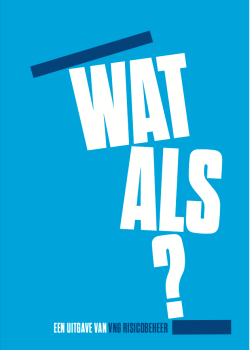
Volgens Kruf (red.: in zijn bijdrage aan Wat als?, een uitgave van VNG Risicobeheer) krijgt risicomanagement niet de bestuurlijke aandacht die het verdient. “Bestuurders zien het vaak als iets negatiefs. Mensen denken graag optimistisch, praten over kwetsbaarheden past daar niet in.”
Kruf wil een lans breken. “Risicomanagement leidt juist tot succes, het helpt bijvoorbeeld om collegedoelen te realiseren. Ik vergelijk risicomanagement vaak met topsport. Kijk naar een Tom Dumoulin of Max Verstappen. Samen met hun team kijken ze wat nodig is om de race te winnen en hoe ze eventuele kwetsbaarheden kunnen ondervangen. Ze laten niets aan het toeval over. Hun drive is om continu te verbeteren in processen, voeding, materialen enzovoorts. Ze willen immers zo goed mogelijk kunnen presteren.”

Ook Tom en Max doen aan risicomanagement

Risicomanagement staat voor Kruf gelijk aan secuur, respectvol én vooral zorgvuldig besturen. “Het is eigenlijk een vorm van topsport. Ieder college wil toch dat zijn programma optimaal en daadwerkelijk wordt uitgevoerd? Risicomanagement voorkomt missers en tegenvallers én helpt bestuurders realiseren wat ze aan hun inwoners hebben beloofd.”

Van weerstandsparagraaf naar paragraaf besturing

Als gemeentesecretaris heeft hij de invoering van de weerstandsparagraaf van dichtbij meegemaakt. “Het was een eerste stap in het integraal denken over risicomanagement binnen regionale en lokale overheden. De weerstandsparagraaf heeft echter vooral een financieel en verdedigend karakter. De berekening van het weerstandsvermogen is erg academisch en wordt door veel raadsleden, bestuurders en ambtenaren nauwelijks begrepen. Het leidt tot vaak vreemde discussies bij de begrotingsbehandeling”, legt Kruf uit.

“Alle kennis is in en rondom het gemeentehuis aanwezig om tot goede sturing te komen. De kunst is de systeemwereld van de overheid open te stellen voor en te verbinden met de leefwereld van de samenleving. Dan komen er mooie oplossingen. De gemeente is immers zelf radar in een groter geheel. Dialoog zorgt ervoor dat deze energie vrijkomt”, benadrukt hij.

Mede daarom pleit hij namens PRIMO voor de invoering van een zogeheten bredere ‘Paragraaf Besturing’. Uit onderzoek blijkt namelijk dat één van de risico’s voor bijvoorbeeld budgetoverschrijding of het niet halen van doelen van collegeprogramma’s ‘het besturen’ zelf is. “Slechts 12% van alle plannen komt tot uitvoering. Dat is weinig effectief en verspilling van middelen”, zegt Kruf. Hij pleit ervoor om inhoud en besturing dichterbij elkaar te brengen, veel dichter dan vaak nu het geval is.

De nieuwe paragraaf zou volgens PRIMO vóóraf moeten vastleggen hoe de (be)sturing van het college- programma eruitziet, bijvoorbeeld welke rol maatschappelijke partners hierin kunnen en moeten spelen en wat voor soort leiderschapsstijl van bestuurders daarbij past. “Iedere opgave vraagt immers om een andere aanpak. Zo is voor de energietransitie een verbindende leiderschapsstijl naar bedrijfsleven en maatschappelijke partners nodig, terwijl cybersecurity gebaat is bij ‘blauwe’ leiders. Door nadrukkelijker de inhoud en de besturing aan elkaar te koppelen, verklein je de risico’s – de afwijkingen van het beoogde – en vergroot je de kans dat je als gemeente daadwerkelijk raak schiet met plannen en projecten”, zegt Kruf stellig.

Einsteins theelepeltje

Om te komen tot een dergelijke paragraaf, heeft PRIMO – ook Europees – een raamwerk met concrete vragen en aandachts- punten voor besturen opgesteld. Dit heeft zij gedaan samen met leden en experts binnen haar netwerk. Dit raamwerk helpt om programma’s en projecten effectief en doelmatig uit te voeren.

“Een college zou bij een nieuw programma zijn gemeentesecretaris en concerncontroller als eerste moeten betrekken om de Paragraaf Besturing te schrijven”, vindt Kruf. Immers, gemeentesecretarissen en concerncontrollers hebben als eerste adviseurs bij uitstek het overzicht over alle onderwerpen én inzicht in het totale krachtenveld.

Kruf gaat verder: “Zij weten hoe inhoud en besturing gekoppeld kunnen worden en wat daarvoor nodig is. Of zoals Einstein het ooit zei: ’in een theelepel zit genoeg energie om een grote stad een jaar lang te kunnen verlichten. De kunst is om het eruit te krijgen’.” Diezelfde energie zit volgens Kruf vaak opgesloten in de betrokkenen: ambtenaren, burgers en bedrijven.

Dialoog zorgt ervoor dat energie vrijkomt

“Alle kennis is in en rondom het gemeentehuis aanwezig om tot goede sturing te komen. De kunst is de systeemwereld van de overheid open te stellen voor en te verbinden met de leefwereld van de samenleving. Dan komen er mooie oplossingen. De gemeente is immers zelf radar in een groter geheel. Dialoog zorgt ervoor dat deze energie vrijkomt”, benadrukt hij.

Het raamwerk van PRIMO helpt deze energie beter te ontsluiten en effectiever te richten. “Uiteindelijk is het aan ieder college en elke gemeenteraad om niet alleen in control te zijn, maar ook te komen tot het beloofde resultaat én dat liefst zo effectief moge- lijk. Middelen zijn schaars en belastinggeld moet optimaal worden besteed.” Kruf geeft een impressie van de vragen die in het raamwerk aan bod komen en die dus vóóraf besproken moeten worden.

___________

10 Vragen voor iedere bestuurder en elk college

        1. In hoeverre is het plan financieel uitvoerbaar en wat zijn de mogelijke financiële risico’s die we lopen?
        2. Welke ontwikkelingen kunnen zich voordoen tussen start en finish en met welke scenario’s moeten we rekening houden?
        3. Kennen wij de problematiek van onze inwoners en organisaties goed genoeg om te kunnen sturen? Hoe adequaat zijn onze diagnoses eigenlijk?
        4. Hoe verbinden wij voortdurend de wereld van de gemeente met de wereld van onze doelgroepen en wat betekent dat voor onzemanier van werken?
        5. Wat pakken we als gemeente op en wat laten we aan de samenleving?
        6. Hoe nemen en tonen wij verantwoordelijkheid voor het wel en wee de stad, haar organisaties en burgers en welke leiderschapsstijl past daarbij?
        7. Wat is nodig in capaciteit en kwaliteit om de bestuurlijke ambities daad- werkelijk uit te kunnen voeren?
        8. Hoe werken we samen met hogere en lagere overheden om onze doelen te realiseren?
        9. Hoe werken wij samen met en sturen wij op partners in de keten, zoals maatschappelijke organisaties, bedrijven, investeerders, wetenschap en onderwijs?
        10. Op welke global goals sturen wij eigenlijk en welke global risks zijn van toepassing op onze gemeente?

___________

Juichend over de finish

Over enkele jaren volgt de invoering van het bestuurlijke ‘in control statement’. In plaats van een accountant moet het bestuur zelf laten zien dat het ‘in control’ is door een verklaring af te geven voor zijn eigen werkwijze en sturing als verantwoording aan kiezer en samenleving. Daarmee wordt de koppeling van inhoud, besturing en bedrijfsvoering een logische volgende stap.

“Juichend over de finish komen is toch de droom van iedere bestuurder”, stelt Kruf. “Dit betekent immers succes. Dus moet je als college nadenken over wat er nodig is om winnend over de streep te komen.” Volgens hem verdient het management van publieke risico’s die verbonden zijn aan zaken zoals klimaatverandering, cybersecurity, maatschappelijke zorg en effectieve energietransitie een plek aan elke college- en managementtafel.

“Dialoog aan de top gaat niet alleen over doelen, maar ook over mogelijke, acceptabele en niet-acceptabele afwijkingen en de daarvoor benodigde sturing. Deze dialoog bevordert de professionaliteit, veerkracht en weerbaar- heid van alle betrokken organisaties. Risicomanagement betekent niets aan
het toeval willen overlaten, secuur werken, over de juiste informatie beschikken, durven innoveren, weten wat de gevolgen voor de samenleving zijn, deze onder ogen durven zien en je plek daarin vinden. Kortom, het is leiderschap tonen en alles aangrijpen om te willen verbeteren, om te willen winnen. Een vorm van topsport dus. Zo bezien is risicomanagement best een sexy onderwerp”, glimlacht Kruf.

Bibliografie

Jeitler, V. en Nan, M. (red.) (2018) Wat als?. Den Haag: VNG Risicobeheer.

De Kloof

Door Jan Breyne* | juli 2012

Dit komt niet van mij. Het komt uit de Memoires van Jean-Luc Dehaene. Maar het is zeker het overwegen waard:

“Aan de basis van de zogenaamde kloof tussen kiezer en politicus ligt een groot misverstand over de opdracht van de politiek. Deze moet niet het eigen belang maar het algemeen belang dienen: haar opdracht is de organisatie en de regeling van het samenleven van burgers. En daarom is de politiek meer op het wijdan op hetikgericht. Maar zo ervaart de geïndividualiseerde burger het niet. En ik geef toe, de politicus heeft dit misverstand mee in de hand gewerkt, onder meer door een uitgebreid dienstbetoon. Maar politici worden daarnaast al te gemakkelijk, ook in de media, afgeschilderd als profiteurs en zakkenvullers, als mensen die bezig zijn met hun eigen problemen, knoeien en verantwoordelijk zijn voor de torenhoge schulden. De burger voelt zich in de steek gelaten, een gevoel dat nog versterkt wordt door de angst die de snel veranderende samenleving bij sommigen oproept. Heel wat zekerheden komen op de helling te staan. Proteststemmen vertolken dat onbehagen. De protestkiezer stemt niet voor maar tegen iets”.

Jan Breyne

Een wijze tekst, die politici, toekomstige politici en wouldbe politici oproept tot bescheidenheid. De politiek lost niet alles op, en hoeft ook niet de schuld op zich te nemen van alles wat verkeerd gaat in de samenleving.

Lees verder “De Kloof”

Risk management at the edge of three worlds

City management in the perspective of ‘risk’

Jack Kruf | mei 2007


In this article I want to focus on the specific characteristics of the role and position of local authority CEO, the city manager, in relation to the three worlds of politics, society and management. And specific focus on the role of risk management in supporting the CEO and the process of discussing these issues,  to emphasise that risk management belongs on the strategic agenda and demands a holistic approach.

The “best” job

Some might say it is the most attractive and fascinating job there is: serving as CEO in local public management, (or city manager or secretary). Why? Because it is at the very heart of dynamic society, close to politics and government, at the center of the world of “power and influence” and at the top of the management pyramid. This person sits at the very junction of necessary skills, ambitions, rights, stakes, and interests. He or she is, via society, close to disas- ters, successes, poverty, environmental challenges, and, via politics, to elected officials like the mayor and local alderman, but always in close contact with officials in higher government, and very close to the professionals in within the organisation. Local government leadership is a very exciting job.

“It is clear that risk management should be seen as a core competence for every public leader”

The CEO is a generalist not a specialist. One might say that a realistic comparison of the job would be with the decathlon. As with decathletes, the CEO needs to be well-rounded, competitive and competent within many different areas.

Furthermore, the CEO cannot operate in isolation but has to be open to the world, always authentic and at the same time able to act as a chameleon. A phrase that has always appealed to me is to be able to walk the web as a spider and be familiar with the rules of chess. This broad spectrum makes the role challenging, very attractive and influential, but also very vulnerable. And it is here where risk management comes into play.

Risk management

As the demands of the city manager job are diverse but inter-connected, so must be the management approach: the manager must possess a broad, non-panicky and non-dogmatic perspective on risk and risk management – one which stresses usability in relation to a wide range of public risk issues, as well as to risks in public organisations.

Such an approach requires a holistic, opportunistic and dialogue- oriented form of risk management, which seeks to harvest the value added, the ethical, resilient, and innovative potential in risk management as a natural part of public governance. 

The management of risks is one of the most challenging issues for the public sector today. Whether risks arise from the physical environment, economic environment, or even from changes in voter preferences, public institutions have a broad responsibility to assess and address the risks that impact the community they serve as well as their organisation. For example, which risks are possible when making investments in a new IT-system? Which elements of risk are to be analysed when decisions about building a new school are made? Which elements of risk are to be assessed in connection with preventing vandalism and break-ins on municipal buildings? And which risks emerge from decisions made by higher governmental institutions? 

It is clear that risk management should be seen as a core competence for every public leader. But what is risk management? In general a way of approaching business, a sound attitude towards and style in managing people, projects and processing as well as in reaching goals. It comprises of course tools and techniques but more than that a smart, honest and external oriented approach – open and authentic. Risk management leads to an effective and efficient way of reaching goals. It is the road to success. Let me focus on the three domains; society, politics and management. 

“One of the major goals for the public sector worldwide is a continuous building and rebuilding of public trust in close combination with sustainable development” 

The three worlds 

The worlds of society, politics and management are always overlapping and connected. This fact requires a new risk management approach. It should consist of more than just preventing losses and reducing costs. Increasingly, risk management can be defined as the coordinated management of all risks. In this regard, modern risk management is a general management function that permeates an organisation, is linked to the organisation’s overall strategic plan and serves to enable the achievement of political and organisational goals and objectives. 

One of the major goals for the public sector worldwide is a continu- ous building and rebuilding of public trust in close combination with sustainable development. Risk management is thus a most valuable management concept and management tool in today’s complex and globalised world with its increasing demands on governance and compliance. 

Risks in society 

The attacks on the World Trade and the Madrid trains, the Indian Ocean tsunami, the financial scandals of Enron and Worldcom, in- creasing poverty, climate change, increasing problems in the supply of clean water, unexpected riots in the suburbs of our cities, the murder of a Dutch politician, the Danish cartoon controversy, and the massacre at Virginia Tech University – all tell us how fragile society is. This underlines the urgency of and demands the control of risks, not only on global but certainly also on local level. 

Risk management requires a knowledge of what is going on in society – how it is developing in our streets, neighbourhoods, vil- lages, suburbs and cities. And knowing requires the measuring and monitoring of stress, satisfaction, trust, safety; that is, perceptions of risk as well as objective and factual measures of risk. Monitor- ing and diagnosing society is important. Understanding relevant trends and developments is critical. 

Risk management also asks us to understand in what way and to what extent institutions in society really cooperate; where they should and why they don’t. This chain of interrelated institutions should be working if we want to be in control. Only the right in- formation can lead to the right conclusions, and the right things to do. So sensing society and its institutions is a form of risk management.

 Of course, we receive some social feedback from citizens during elections. But it is my view that we need to develop a more consistent and permanent way of monitoring and sensing the state or health of society and the risks within it. This will contribute to an overall improvement in the quality of federal and local policies. And if set up internationally, which it should be, lead to more exchange of knowledge and experience between local authorities worldwide.

Risks in politics 

It is the task of the CEO to advise his local politicians as effectively as possible, to prevent and even to protect them from risks. This boundary between politics and management requires special attention. Politicians often have a different view of risks than specialists and professionals. The approach here is to invest in the awareness of risks and to put it on the common strategic agenda. This seems so easy but actually is not. Politicians and managers do not always speak each other’s language. On the other hand the local govern- ment is an entity committed to the development of policies and legislation by politicians on a regional, national and European level. Yes there is the fact these are sometimes difficult to implement or if so against high costs and with intense efforts from municipal organisations. 

Risk management compels us to consciously calculate the risks and bring them forward. National organisations should play a key role in this. In my view we should invest in partnerships between the different governmental layers. The other approach is to share your experiences in implementation, synchronisation and cooperate in this as much as possible. In the long term, higher levels of government should involve lower levels of government in policy development and implementation. The best form of risk management is a true partnership. 

Mind you, another factor that local government has to deal with is the lack of cooperation on a higher level. Central governmental institutions and ministries are organised by sector: traffic, environment, agriculture, economic, social, legal et cetera. An integrated approach of specific areas, projects, problems or target groups and even individuals is often literally blocked by this compartmentalisation. And this fact itself leads to higher risks for “control” of society. The result is, for example, legislation which is not consistent and may even be contradictory at the local level. 

“Mind you, another factor that local government has to deal with is the lack of cooperation on a higher level.”

Introducing risk management here implies bridging the gap between the compartmentalized nature of government and the need for integration, truly a real challenge for the city manager, generalist, process engineer, chameleon and spider as he or she may be. 

However, reducing the risks of a non congruent and consistent approach on a local level caused by compartmentalisation is often very difficult and frequently impossible. Most power and influence, laws, regulations and budgeting of projects are organised along such sectoral lines. This causes high risks for society. Bridging those gaps may be one of the highest forms of risk management. 

In general it is very clear that a broader approach to risk management can lead to successful projects and policies and from there to successful local politics and politicians. While this seems obvious, it has not always been that way. Indeed, often risk management is seen as an obstacle to political goals and ambitions. I would simply argue here that risk management enables the fulfilment of goals, and if it isn’t happening in an organisation, well, risk management is not being effectively practiced.

“Introducing risk management here implies bridging the gap between the compartmentalised nature of government and the need for integration…”

Risks in management 

The CEO is, in general, responsible for the management of the municipal organisation. And as every manager, he or she has to be perfectly in control and therefore be able to realise the political targets. In this the CEO is, with mayor and alderman, also responsible for the mistakes/faults of the local organisation. In this context, risk management has a lot to do with minimising errors, mistakes and accidents. Preventing crises and disasters and, if they occur, doing the right things. 

Another factor is that good news always travels fast to the top, but the bad news often stays hidden. Most employees never enter the room of the executive to tell the top manager that a decision is very risky and that it will lead to trouble. This would be, as they say, not a good career move. That is the reason that it should be the CEO who puts risk management high on the strategic agenda, as an invitation and a request to employees in the organisation to come forward. Beyond that, he or she has to develop a safe and open culture for employees to talk about risks and, more importantly to reduce them. Most CEOs today delegate directly to others. But it is my opinion that this is a risk in itself. Risk management requires the involvement of all members in the management team, and it requires that they all explicitly share the risks. 

Another important aspect of the job of CEO is realising political targets. This demands a management style focused on results. Defining the goals and auditing the risks of not realising them can give an enormous stimulus to develop and focus employees on those results. This is risk management pur sang and can assure success and improved control. In this regard the CEO needs to be open and transparent in his approach to facing risks. In my view the process of reducing risks and uncertainties is often too implicit, sometimes even hidden and not visible. 

To prevent the organisation itself approaching risks sectorially it is worthwhile considering the “bundling” of control in the organisation in one place, of course with the checks and balances embedded and incorporated. Legal, IT, financial and quality officers often don’t talk with each other because they have their own specialisms. The city manager also has to develop an integrated approach, as it will improve the quality of political advising, addressing the needs in society and fostering higher quality decisions. 

The necessity of sharing 

In my judgment, all of the preceding comments underscore the importance of sharing—that is, the sharing of ideas, techniques, and strategies among public sector managers. For reasons that escape me, we do not see the level of sharing (between local authorities, between local and central governments, and – yes – between governments of various nations). But sharing is necessary, in significant part because of globalisation. We can learn a lot more if we are prepared to look around us and learn from each other, share our experiences and approaches. 

To encourage and facilitate the goal of sharing, a new visionary and comprehensive risk management organisation for public risk management on a CEO-level has been set-up. It is called the Public Risk Management Organisation (PRIMO). It is an international association that strives to establish an influential trans-national network for creating awareness, to set up networks, to connect people, to develop and disseminate well-founded, solid, useful and cutting-edge knowledge on public risk management for the benefit of society, the citizens and the public organisations. 

Just get started 

Risk management has a good scientific basis, though it is relatively young in the public sector. But there are sufficient tools and techniques available to start. Put risk management high on the strategic agenda. Start the debate about the most experienced risks, create a safe atmosphere and culture in which it is possible to share and bring forward risks. Identifying the risks is a start in itself and the first step for reducing risks and uncertainties on projects, advising and processes. And, I want to underscore this final point; it has to be the city manager who sets the example and leads the way.


This essay is a replica of the article as published in the magazine Public Risk Forum May 2007.

Image: Jack Kruf (2020) Valorising the City [fine art print].

Lees verder “Risk management at the edge of three worlds”

25+ years risk management

Why 75 essays spanning more than 25 years have been brought together in the e-book ‘Publiek Risico: Essays’: to inform and to inspire

Eric Frank en Jack Kruf | August 2020


The principles of risk management are inherent in every ecosystem and, as far as humans are concerned, are some 300,000 years old. Every human still has stored in his brain the early stages of development. To survive as a group or as individuals. It occurred to us that these basic principles are palpable in the thoughts expressed in this selection of essays. Much of it is essential.

Now, anno 2020, we look back. For 15 years (period 2006-2020) we have been alternately responsible for the establishment, control and management of the Dutch branch of PRIMO, the Public Risk Management Organisation. A good time to present a selection of essays that gives a picture of the origin, the functioning and the development of the risk management profession. This is the introduction to the e-book Publiek Risico: Essays (in Dutch).

It is a personal selection, in which, in our view, the various angles of the field are most strongly displayed. It is a selection, which we know is selling people short, of course. But the choice of a limited set of essays and pages forces one to choose. It is 75 essays and 723 pages. Bundled in this e-book.

Risk management as a profession is as old as the road to Rome

Risk management as a profession is as old as the road to Rome (and actually much older as already indicated above), but the starting point for the Netherlands is laid in 1995, in the run-up to the process whereby the central government in the Netherlands planted the first seeds. Not really for itself, no, not really, but to devise a construct in which it could decentralize tasks to lower governments and then to enforce supervision of their execution. So divest and see that it goes well. A special reason, then, which is not so much the public good but rather the mechanism of control. That is the first thing that strikes one.

The selection of articles shows the interpretation of this approach, also shows that many experts and scientists have contributed many new ideas to it, but the central government has not really changed its mind in terms of position and approach in those 25 years. There is actually the paragraph on resilience as the only real framework. Although this is legally complied with, many municipalities hardly apply it as a real steering instrument.

What is also striking is that the municipalities, provinces and water boards are actually not at all organized in this regard, even after 25 years. Everyone works with their own approach, with their own frameworks, models, consultants and even their own scientists. There is hardly a corporate framework with which municipalities, provinces and water boards work.

Only 25 years after the government made the decision to work this way, the umbrella organizations are showing, albeit sparsely – incidentally, on a project basis and usually facility by facility – a sign of life on this issue. This is noticeable in the selection. Essays from these are lacking. The essays come mainly from a few front runners in the public domain, scholars or external consultants.

A search of the public administration itself has very moderate results

Risk management has not landed, it is for many directors and top managers a fremdkörper. It has not become a management tool for sailing sharply to the wind, innovating and looking ahead. It is a must, and sometimes even a washing-up job.

Risk management is still a push model, actually an unwanted child of the government, in which consultants and commercial parties have of course provided a breath of fresh air, but also in which they came up with special ideas, approaches and models. And above all, the diversity of definitions and explanations is enormous. It seems to have become a polluted term, a container. This causes great confusion and hap-snap business. This is where the shoe pinches with regard to public risk management. The playing field is divided and there is no unified language.

Our selection of articles is a call to really take up the gauntlet and re-evaluate the wealth of knowledge and ideas before us, to use them and above all to get to work. The ball is in the court of the board and top management. This requires authority and, above all, support and consistency from the top of the ministries.

After 25 years, we are still kind of where we were 25 years ago: most directors and top managers don’t feel like adopting this profession profession professionally at all. Their explanation is that it is negative, inhibiting, not motivating, avoiding. Of course, this is nonsense, but perception is sometimes stronger than reality. The core of the profession is knowingly not understood. There is work to be done, a lot, indeed a lot. This selection contains the ingredients.

In front of you is a journey of more than 25 years, which also shows that good ideas have been launched and many attempts have been made to broaden the profession and make it mature. Some of these, in our view, are worth sharing and deserve to be put on the drawing board for the continued development of the profession. We wish you a reading with pleasure and inspiration. Ω

Lees in Nederlands

Colofon

Editorial: Eric Frank (language editor, Dutch) en Jack Kruf (final editor). With thanks to all authors for their contribution.

ISBN/EAN: This book has been registered in 2013 and published in 2020 at Centraal Boekhuis as Publiek Risico: Essays, with ISBN-number 9789491818011.

Publication: This e-boek is exclusively and on personal insights of the editors composed and curated. It is published by Governance Connect. On the 1st of January 2022 the rights have beeb taken over by Civitas Naturalis Foundation. The publication has been disseminated in the network of public managers in The Netherlands and Flanders and is used by PRIMO Nederland and PRIMO Europe for support in their education programs.

Rights: All rights reserved. No part of this publication may be reproduced, stored in a retrieval system of transmitted, in any form or by any means, electronic, mechanical, photocopying, recording and/or otherwise without the prior written permission of the publishers. This publication may not be lent, resold, hired out of otherwise disposed of by way of trade in any form, binding or cover other than that in which it is published, without the prior consent of the publishers. No rights can derived from the contents of this book.