Zou het niet mooi zijn dat je als bestuurder, manager, medewerker ook in de gelegenheid zou zijn, in de modus mág staan, om gewoon te ontdekken hoe iets zit. Hoe bijvoorbeeld burgers tegen een vraagstuk aankijken, hoe zij zich voelen, hoe verbanden gelegd kunnen worden, wat de kern van het probleem is, de kwestie die voorligt, hoe leden van jouw team of college aankijken tegen een voorliggend plan of project, in alle openheid en eerlijkheid.
En dit alles uiteraard zonder door anderen een mogelijke onwetendheid te worden toegedicht (“Wist jij dat niet?”). O ja, dat is de achilleshiel voor ons bestuurders en managers. Wij kennen onszelf, dat vooral, maar hebben in de vele jaren van publieke dienst in het hart van het lokaal bestuur ervaren, dat deze eigenschap voor velen een dingetje is.
De ‘O’ van ‘Ontdekking’ mag wat ons betreft opnieuw op de borden als les 1 in het openbaar bestuur. Het willen weten. Nieuwsgierig mogen zijn, met open vizier kunnen kijken. Veilig, en altijd met een boei nabij. Dat zou mooi zijn. De ‘Ontdekking’ die daarmee zelf de reddingsboei voor goed bestuur wordt.
Een warm pleidooi van de Heren van Oranje voor de ‘Ontdekking’. Zij beschouwen dit als logisch onderdeel van het binnen het resilience-perspectief geroemde inclusieve denken en handelen. Toch komen wij het maar zelden tegen in de dagdagelijkse praktijk van politiek, bestuur en management.
Het begrip inclusief denken en handelen wordt door het internationale netwerk van resilient cities als basisfilosofie geduid om een stap te zetten in de kwaliteit van openbaar bestuur. Het wordt alom geroemd als dé weg voorwaarts. Het wordt beschreven als prioritise broad consultation to create a sense of shared ownership in decision making.
Ontdekken hoort daar volgens ons zeer bij, en is daarvan zelfs een kernonderdeel. Er valt nog zoveel te ontdekken! Dus? De paden op en de lanen in, denken wij. Ontdekken dus.
To make sense from data around you makes sense. Expressing your findings with warm, familiar materials like wood, paper, wool, leather and glass can make to a form of art. And there is a vast amount of data around us, in fact we live in it. Laurie Frick is an artist who is driven to tell her story.
She collects the data herself with a variety of as she calls rigorous methods and with that come to hand-made patterned wall-arts. The physicality of her expressions leads in Frick’s conviction and philosophy to a better understanding what our bodies and behaviour tell us, make the vast amounts of numeric data from abstract to tangible, because people can understand the patterns intuitively. Colours play an important role.
The image above has been taken from lauriefrick.com. It is worth visiting, because it inspires, it is a beautiful bouquet of works and it gives you the opportunity to acquire one of these professionally hand-made unique masterpieces.
I caught this two traits of humanity into this one image. I thought a lot of it actually how to express my thoughts in this strangely destructed part of the forest. Tears came into my eyes, to see a bunch of beeches been cut off in this way. I asked myself, as ecologist, forester, walker, human being: why?
I wondered, as watcher of the skies (thanks Genesis), what on this picture the ‘traits of humanity’ are, which actually meet. Quite a moment during my walk in the forest.
To choose, implement and communicate a business model is challenging. It can at the same time be inspirational, strategic and for business continuity necessary, with the eye on the market, the client and of course the competition. I collected some frequently used models and main techniques used at board rooms in government, business and non-profit.
In the office you can express and communicate your core philosophy and business approach with your clients, customers and guests. With that you can make a statement. Showing them as wall-art can possibly contribute to the branding and understanding of your company.
Colour management
The Pantone® colours in our design are hand-picked, corresponding with the biomes, for accurate colour management and print reproduction. Note: the colours in the slides shown here may differ from those of the actual prints.
Delivery
Risk
Steering in dynamics
Performance
Public Finance
Quality
Strategy
Delivery
One of the most relevant cycles in business is that of delivery, the cycle of Production-Service-Check-Improvement. It is where the place where all strategies, policies and investments lead to the actual services. Customer satisfaction has to be checked and, based on this, improvements need to be made. It is the cycle where businesses are at the closest to the clients and governments to the citizens they serve. Delivery counts. It is perceived as one of the most critical ones for business continuity and customer satisfaction.
Risk
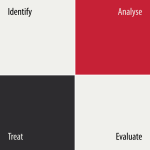
The ISO 31000 guideline is about risk management. The major steps in the process are Identify-Analyse-Evaluate-Treat. International Organization for Standardization in Geneva underlines for the long-term success of an organisation, the reliance on many things, from continually assessing and updating their offering to optimising their processes. Addressing operational continuity is key, providing a level of reassurance in terms of economic resilience, professional reputation and environmental and safety outcomes. The cycle has many variants, and depends on the school of philosophy or commercial approach.
Steering in dynamics
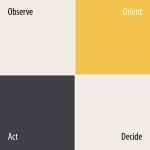
The Observe-Orient-Decide-Act loop shows that all decisions are based on observations of the evolving situation tempered with implicit filtering of the problem being addressed. It is about steering in, sometimes high, dynamics. The concept of OODA was developed by military strategist and United States Air Force Colonel John Boyd. He applied the concept to the combat operations process, often at the operational level during military campaigns. It is now also often applied to understand commercial operations and learning processes. The approach explains how agility can overcome raw power in dealing with human opponents.
Control and improvement
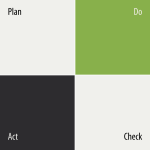
The Plan-Do-Check-Act loop is an iterative four-step management method used in business for the control and continual improvement of processes and products. The concept of PDCA is based on the scientific method. A fundamental principle here is iteration – once a hypothesis is confirmed (or negated), executing the cycle again will extend the knowledge further. Repeating the PDCA cycle can bring its users closer to the goal, usually a perfect operation and output.
Performance
Performance management is working in the cycle Plan-Develop-Perform-Review. It is an ongoing process of open communication in support of accomplishing the strategic objectives of the organisation, team or person. The communication process includes clarifying expectations, setting objectives, identifying goals, providing feedback, and reviewing results.
Publicfinance
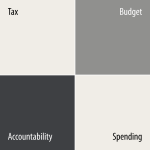
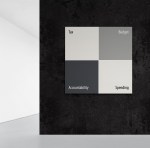
The cycle of public finance, that of Tax-Budget-Spending-Accountability in fact is a simple one, but one of the most crucial ones in present approach of major social and economical challenges. Government needs tax as its basis, decides how to budget their plans, products and services, then spend the money for production, implementation and delivery and at the take accountability for this to its voters, clients and citizens. It is a cycle, that repeats itself every year, on all levels of government.
Quality
The Common Assessment Framework (CAF) is about the connection of Leadership-Resource-Process-Result. It is use as the European quality management instrument for the public sector. It is there to assist its organisations to improve their performance. This quality framework helps the organisations to perform a self-assessment, to develop an improvement plan based on this and to implement the improvement actions. The model is based on the premise that excellent results in organisational performance, citizens/customers, people and society are achieved through leadership, driving strategy and planning, people, partnerships, resources and processes.
Strategy
One of the most heard and used terms in the public sector is the word strategy. In times of change it is considered as the model which shares light on the path towards the future. One of the cycles is Diagnosis-Course-Policy-Implementation. It is about the process of defining a new course, based on proper diagnosis and with the explicit purpose or at least intention to elaborate the course into policy (read: planning) and at the end implementation. Strategy can be considered as a cycle – as it has done here – but is often is used as stand-alone step on its own. The cycle has many variants, and depends on the school of philosophy.
_____
On location
Every design is available for print. The models are designed in a consistent way, for a broad use and applicability in a wide range of dimensions, from postcard to ‘museum’ dimensions. Here you find a selection of the collection for gallery, hall, home, office, outdoor and public space. Showcasing them in rooms where clients or guests meet raises the awareness of the richness of concepts, thoughts and wisdoms.
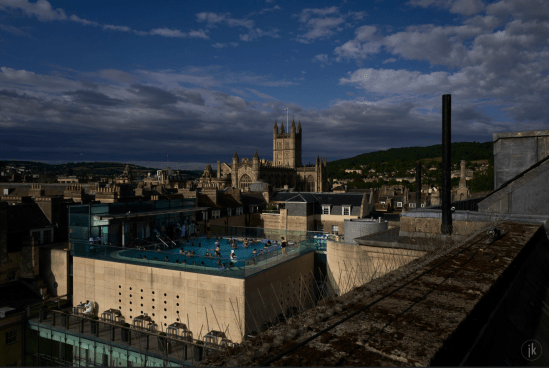
There are cities where even the name is inclusive to its brand and gestalt. The city of Bath, Somerset, is famous for its well preserved Roman baths, which were built around 60 AD. It is a place of spa, still.













 Kruf Huyssons