I designed an intelligent pawn, called Equoi. It is in essence a simple concept, like that of the barometer or thermometer. It measures the mood of an object, place or process. The pawn is virtually full of sensors. Its application is easy: just put it on the table, ask your question, wait a moment and Equoi tells you the how and the what.
Following the Sustainable Development Goals, climate change is despite Covid-19 not forgotten. More so, the last is seen by scientists, managers and experts as an omen what we can expect when we keep disrupting the Earth ecosystem. Goal 13 is Climate Action: Take urgent action to combat climate change and its impacts. This goal has 5 targets:
Strengthen resilience and adaptive capacity to climate-related hazards and natural disasters in all countries.
Integrate climate change measures into national policies, strategies and planning.
Improve education, awareness-raising and human and institutional capacity on climate change mitigation, adaptation, impact reduction and early warning.
Implement the commitment undertaken by developed-country parties to the United Nations Framework Convention on Climate Change to a goal of mobilizing jointly $100 billion annually by 2020 from all sources to address the needs of developing countries in the context of meaningful mitigation actions and transparency on implementation and fully operationalize the Green Climate Fund through its capitalization as soon as possible.
Promote mechanisms for raising capacity for effective climate change-related planning and management in least developed countries and small island developing States, including focusing on women, youth and local and marginalized communities.
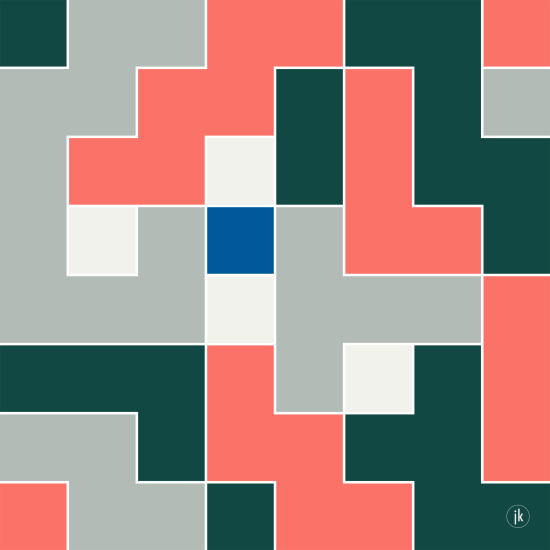
My personal expression of climate change is displayed above. I imagined the canvas of our world as a chess board with 8*8 fields and estimated the relatively most hurt ecosystems due to this change: coral reef (Pantone Living Coral ) and tropical rainforest (Pantone Forest Biome).
Government (Pantone Imperial Blue) is in fact a tiny spot on the canvas because it is doing not that much to tackle or change course. Most of the public leaders are still in denial or have no idea how to come into action. And we as citizens are not active either and go on with daily life. Storm (Pantone Storm Gray) is coming.
It is a personal art impression – or maybe better: an expression of an impression – to remind me that we will loose precious life if we continue this way. The present myriad of life is still so abundant in coral reefs and tropical rainforests, we can hardly imagine.
If you have seen these ecosystems, you understand and fall in love immediately. And if this happens there is not turning back, you want to protect and want to stay it forever to be there. I am in love, still (it is actually since 1977, the year I met (my) Professor Roelof Oldeman and with him did my first discoveries in and of the forest).
I am a realist, not a pessimist. I hear you thinking. But I did my homework as Wageningen University ecologist. Believe me, storm is coming, if we keep sitting on our hands. Maybe this small (art) expression is a small contribution to one of the targets of this sustainable development goal.
The colours of climate change will change over time. The coral reef and rainforest colours will disappear over time. A lot of gray will come in and the tiny spots of goverment remain insignificant as they are now, I’m afraid. The driving political landscape is too dominant, too volatile and too focused on short term gains and profits. Remember I am not a pessimist, but a realist. The scientist in me remains. I like the colours. I hope they stay.
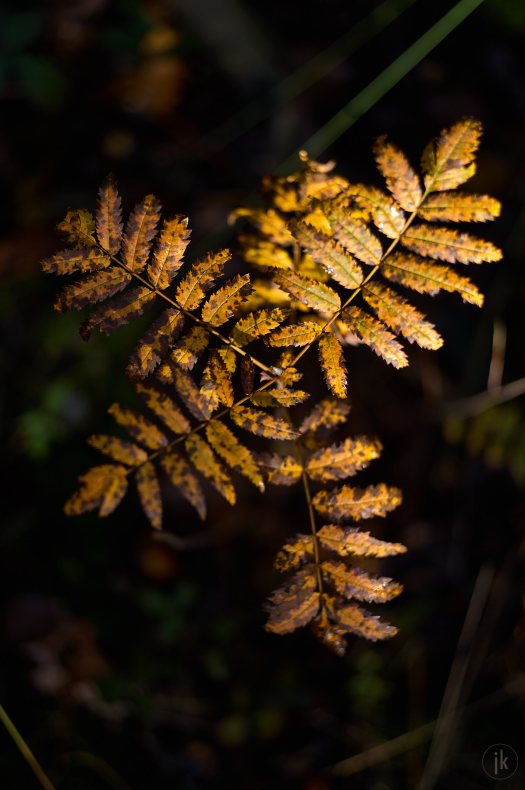
On the forest floor I found this small Rowan (Sorbus accuparia L.). I estimate 15 cm high. At the Ulvenhoutse Bos in Breda, the autumn light felt in on the forest floor in the late evening and reached this young tree. The colours are that of the true palette of autumn and where this time of year stands for: finalise a year of (here first) growth, prepare for winter and get ready for the year to come. Letting the leafs go is crucial for a new start in spring. “How beautiful.
The earth’s forests are havens of nature supporting a diversity of life. Shaped by climate and geography, these vast and dynamic wooded spaces offer unique ecosystems that shelter complex and interdependent webs of flora, fungi, and animals.
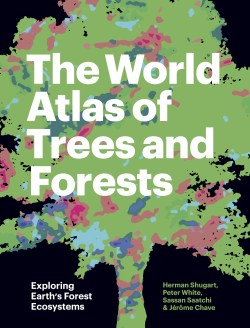
The World Atlas of Trees and Forests offers a beautiful introduction to what forests are, how they work, how they grow, and how we map, assess, and conserve them. It contains things of need to know. And of course the wisdom Hallé, Oldeman, and Tomlinson:
“A third insight into tree forms comes from the work of Hallé, Oldeman, and Tomlinson. Their scheme overlaps with some features of Corner’s rules in that it is particularly concerned with the pattern of branching. It is distinctive, though, in its emphasis on dynamics of development from seed to adult plant, its emphasis on the spatial position of growing points that produce branching, and its inclusion of where and how reproductive structures are produced. The authors described 23 models for the development of tree forms, naming each for a prominent botanist. Taking the palm form (single unbranched, thick stems and many large leaves) as an extreme in Corner’s rules. They named it Corner’s model.”
The book:
Provides the most wide-ranging coverage of the world’s forests available.
Takes readers beneath the breathtaking variety of wooded canopies that span the globe.
Profiles a wealth of tree species, with enlightening and entertaining natural-history highlights along the way.
Features stunning color photos, maps, and graphics.
Draws on the latest cutting-edge research and technology, including satellite imagery.
Every day I read a million news articles, I listen to a million talk shows, I watch a million documentairies, I scan a million scientific publications, I receive a million social media messages, I think about a million promises by our leaders, I see a million best pictures, I learn about a million frameworks, methods and models, I see a million pictures of happy people at a million conferences with a million of flowers, certificates, honours and medals, I cry a million tears for them dying from poverty and hunger, I wonder about a million leafs falling again and again and I keep a million hopes alive.
I sit quietly beside Frodo on the floor of the deep forest after Galadriel has left us. I listen to a million echoes around me and just wonder about the world and what to do next.
Through woven woods in Elvenhome
She lightly fled on dancing feet,
And left him lonely still to roam
In the silent forest listening.


 Kruf Huyssons