
Reading the book ‘Poems’ by Emily Dickinson. In the preface two of her friends describe how they found, perceived and eventually published (after her death) the poems. The description of their first perception is a poem on its own:
“In many cases these verses will seem to the reader like poetry torn up by the roots, with rain and dew and earth still clinging to them, giving a freshness and a fragrance not otherwise to be conveyed.”
As if you can feel, taste here poems from here. They are as original as the woman who wrote them. Straight from the Earth and written with the heart.
Inspiring, again and again, to stretch and challenge the openness and the boundaries of my own perception. Emily has a wide range of doors of perception.
Although Dickinson was a prolific private poet, fewer than a dozen of her nearly eighteen hundred poems were published during her lifetime. The work that was published during her lifetime was usually altered significantly by the publishers to fit the conventional poetic rules of the time. Although most of her acquaintances were probably aware of Dickinson’s writing, it was not until after her death in 1886-when Lavinia, Emily’s younger sister, discovered her cache of poems-that the breadth of Dickinson’s work became apparent.
I am a fan of Emily, forever.
The colours of climate change

Following the Sustainable Development Goals, climate change is despite Covid-19 not forgotten. More so, the last is seen by scientists, managers and experts as an omen what we can expect when we keep disrupting the Earth ecosystem. Goal 13 is Climate Action: Take urgent action to combat climate change and its impacts. This goal has 5 targets:
-
- Strengthen resilience and adaptive capacity to climate-related hazards and natural disasters in all countries.
- Integrate climate change measures into national policies, strategies and planning.
- Improve education, awareness-raising and human and institutional capacity on climate change mitigation, adaptation, impact reduction and early warning.
- Implement the commitment undertaken by developed-country parties to the United Nations Framework Convention on Climate Change to a goal of mobilizing jointly $100 billion annually by 2020 from all sources to address the needs of developing countries in the context of meaningful mitigation actions and transparency on implementation and fully operationalize the Green Climate Fund through its capitalization as soon as possible.
- Promote mechanisms for raising capacity for effective climate change-related planning and management in least developed countries and small island developing States, including focusing on women, youth and local and marginalized communities.
My personal expression of climate change is displayed above. I imagined the canvas of our world as a chess board with 8*8 fields and estimated the relatively most hurt ecosystems due to this change: coral reef (Pantone Living Coral ) and tropical rainforest (Pantone Forest Biome).
Government (Pantone Imperial Blue) is in fact a tiny spot on the canvas because it is doing not that much to tackle or change course. Most of the public leaders are still in denial or have no idea how to come into action. And we as citizens are not active either and go on with daily life. Storm (Pantone Storm Gray) is coming.
It is a personal art impression – or maybe better: an expression of an impression – to remind me that we will loose precious life if we continue this way. The present myriad of life is still so abundant in coral reefs and tropical rainforests, we can hardly imagine.
If you have seen these ecosystems, you understand and fall in love immediately. And if this happens there is not turning back, you want to protect and want to stay it forever to be there. I am in love, still (it is actually since 1977, the year I met (my) Professor Roelof Oldeman and with him did my first discoveries in and of the forest).
I am a realist, not a pessimist. I hear you thinking. But I did my homework as Wageningen University ecologist. Believe me, storm is coming, if we keep sitting on our hands. Maybe this small (art) expression is a small contribution to one of the targets of this sustainable development goal.
The colours of climate change will change over time. The coral reef and rainforest colours will disappear over time. A lot of gray will come in and the tiny spots of goverment remain insignificant as they are now, I’m afraid. The driving political landscape is too dominant, too volatile and too focused on short term gains and profits. Remember I am not a pessimist, but a realist. The scientist in me remains. I like the colours. I hope they stay.
The World Atlas of Trees and Forests
This book is noteworthy. The World Atlas of Trees and Forests: Exploring Earth’s Forest Ecosystems by Herman Shugart, Peter White, Sassan Saatchi, and Jérôme Chave. It is a marvelously illustrated look at the world’s diverse forests and their ecosystems, published by Princeton University Press.
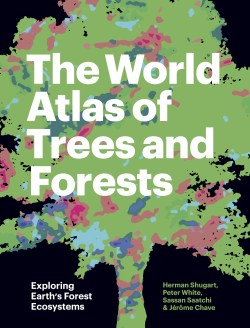
The earth’s forests are havens of nature supporting a diversity of life. Shaped by climate and geography, these vast and dynamic wooded spaces offer unique ecosystems that shelter complex and interdependent webs of flora, fungi, and animals.
The World Atlas of Trees and Forests offers a beautiful introduction to what forests are, how they work, how they grow, and how we map, assess, and conserve them. It contains things of need to know. And of course the wisdom Hallé, Oldeman, and Tomlinson:
“A third insight into tree forms comes from the work of Hallé, Oldeman, and Tomlinson. Their scheme overlaps with some features of Corner’s rules in that it is particularly concerned with the pattern of branching. It is distinctive, though, in its emphasis on dynamics of development from seed to adult plant, its emphasis on the spatial position of growing points that produce branching, and its inclusion of where and how reproductive structures are produced. The authors described 23 models for the development of tree forms, naming each for a prominent botanist. Taking the palm form (single unbranched, thick stems and many large leaves) as an extreme in Corner’s rules. They named it Corner’s model.”
The book:
-
- Provides the most wide-ranging coverage of the world’s forests available.
- Takes readers beneath the breathtaking variety of wooded canopies that span the globe.
- Profiles a wealth of tree species, with enlightening and entertaining natural-history highlights along the way.
- Features stunning color photos, maps, and graphics.
- Draws on the latest cutting-edge research and technology, including satellite imagery.
State of the World’s Plants and Fungi
The State of the World’s Plants and Fungi report by Royal Botanic Gardens Kew is actually breathtaking. You experience the richness of Mother Earth and feel how nature has evolved in all its diversity. However…
In coordination with 97 other institutions in 42 countries, this renowned institute comes to the disconcerting conclusion of how fast and dramatically the decline of biodiversity is going. Data have been compiled. With this report comes information.
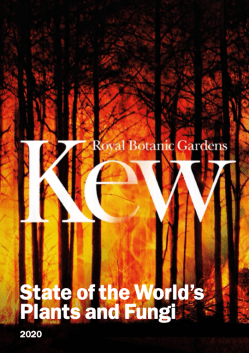
The report offers many tools to improve and shore up. Worth reading, not only for enthusiasts and professionals in the field, but actually for anyone who loves life. After all, there is that calculation of the risk of extinction: 40 per cent of plant species are threatened with it. We don’t want that. Right? Unthinkable actually. A must read for any public leader.
Picture from rapport Kew Gardens (p. 22): “Maize is one of the most widely grown crops but much diversity remains available to breeders.”
Leaf ’68’

Can this leaf of a Lombardy poplar (Populus nigra ‘Italica’ L.) tell the story of a stage, a feeling, an age? Can it be a metaphor for actual fitness, vitality, resilience while representing the signs of life?
I found this leaf near the sacred burial place of my grandparents, where the high slender trees touch the heaven. I spend some time with it. My pencils found their way.
’68’ is a number to be respected and to be remembered. It’s delta shaped form indicates that keep learning is an important implicit message. Its fine geometric architecture also reflects the basic forms of the trees carrying the branches and leafs. In fact it showcases how nature masters its morphogenetic and physiologic plan for growth and development. A wise leaf it is.
Bibliography
Kruf, J.P. (2022) Leaf ’68’ [fine art print]. Breda: Private collection.
 Kruf Huyssons