Forest floor palette

In early December, this is what this palette of the frosty forest floor is telling us. Quite a set of late autumn colours of lost leafs. They look up to where to came from, the high canopies.

We should be very thankful to them for their incredible service this season, this for their production of O2 (oxygen) and binding CO2 (carbondioxide), for their delivery of sugars for trees, fungi and animals, for filtering the dusty air.

Leafs are key for life. They actually are the master servants in the Empire of the Sun. Now they rest in peace on the forest floor, waiting to find their way in the circle of life. Winter is coming.

Picture: © Jack Kruf

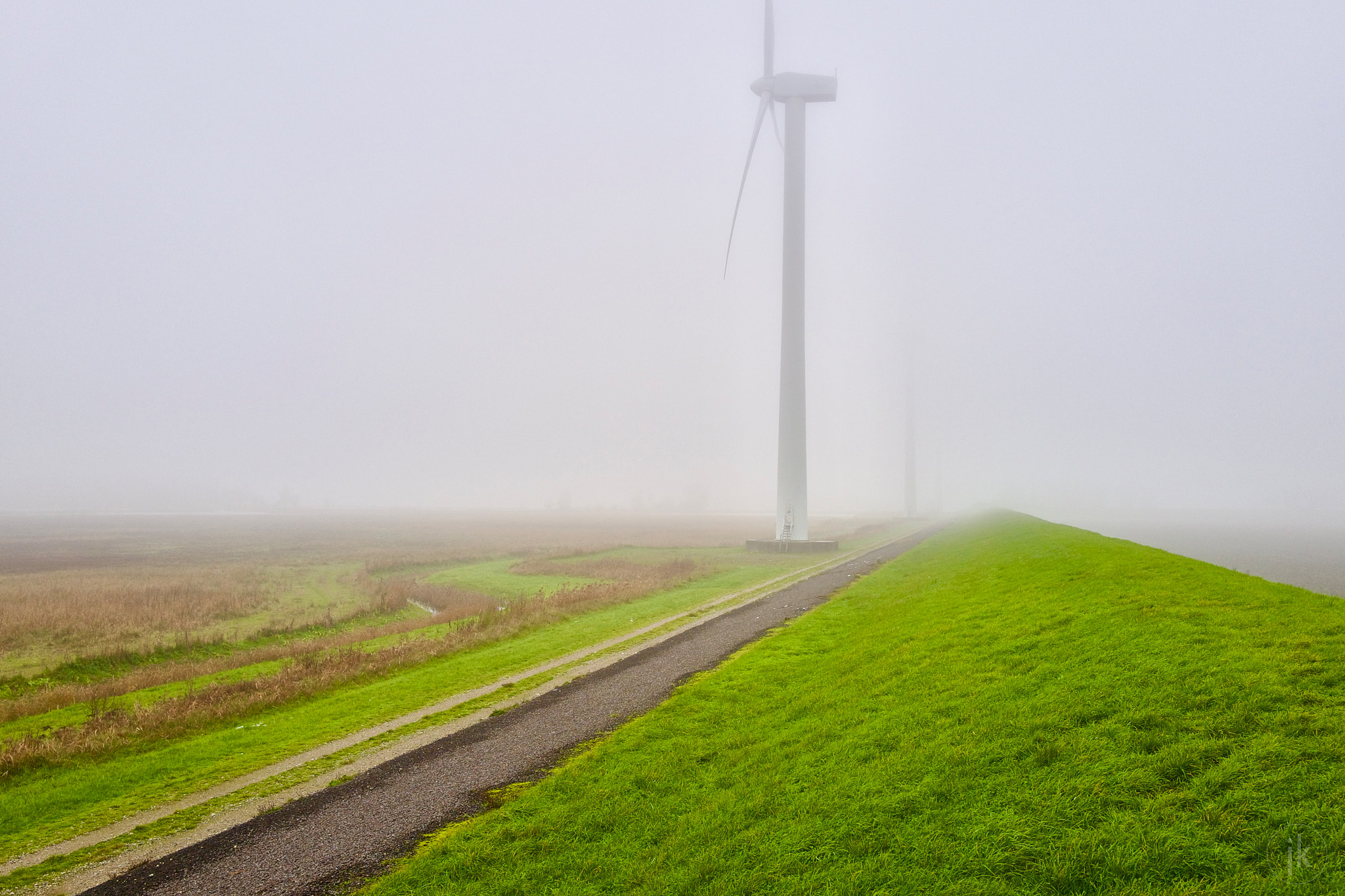
De oneindige dijk

© Jack Kruf (2022) De Halsterse dijk: de oneindige dijk. Breda: Private collection.

Vandaag was ik in de beslotenheid van dit mistige landschap. Wandelend met neef Walter. De ‘Halsterse Dijk’, een monument op zichzelf. Het gebied veranderde van het zoute getijdendeel van de Zeeuwse Delta in een zoetwatergebied. De Deltawerken spreken de taal van de vooruitgang en van veiligheid. De werken waren zo nodig na de overstroming van 1953.

Veel herinneringen liggen besloten in de harten van hen die ook hier hun geliefden verloren. Die verliezen zijn ingebed in de cultuur van de gemeenschap waar ik ben opgegroeid. De lijnen van oneindigheid tonen zich, wederom, op dit moment. Het is de dijk van oneindigheid.

Hier zie ik mijzelf ook weer met mijn moeder, samen genietend van de plek, van het ravotten in het zoute zeewater. Het zoute water maakte het zwemmen lichter. Mijn vader wist als docent wis- en natuurkunde uit te leggen hoe dit allemaal werkt.

Nu bedekt het mistige landschap de warme zomerdagen van weleer. Die verre vreugde is in deze vrieskou nauwelijks voelbaar. Maar het is er nog. Ik geniet nog steeds van de moederlijke warmte en geborgenheid. Zij was de getrainde zwemster, onverschrokken en dapper. Mijn heldin. Één met de zee, met alle respect voor het leven, dat zich hier afspeelde. Hier ligt de geboorte van mijn respect voor de natuur. Oneindige herinneringen. Het is de dijk van oneindigheid.

Public Steward

Public steward or steward of the public domain? Who at the end is taking care for our society as a whole? Bringing balance between the political world (according Machiavelli the domain of power and influence’), society, the natural environment, relevant public values, science, media and business.

Is it the system of human society itself, democratic or not, functioning or not, which is actual self-governing? Or maybe is it the King as steward, guarding us, and not being part of the political system. Can the popularity of Kings and Queens (still) be explained by the fact that we actually are in serious need for a  steward which is guarding and guiding? Or are they a sublimation of our own personal feelings about lack of security and safety in the big world?

Etymology

In old English stiward, stigweard means “house guardian,” from stig “hall, pen” + weard “guard.” So  meaning “overseer of workmen”, attested from c.1300. The sense of “officer on a ship in charge of provisions and meals” is first recorded mid-15c.; extended to trains 1906.

A steward was the title of a class of high officers of the state in early England and Scotland, hence meaning “one who manages affairs of an estate on behalf of his employer” (late 14c.). The term developed during centuries, step by step, from the level of household to that of the public domain. What emerges here is the fact that government should not only deliver products, services, enforce rules, collect taxes and making regulations but also act as a steward. Taking care. Guardian angel.

Religion & Thought

The thoughts of stewardship are embedded in many beliefs, ideologies, philosophies and religions such as Buddhism, CatholicismGaiaHinduismHumanism, IslamismJudaismProtestantism and many more.  According David Horrell the oldest and most influential source for the idea that humans are meant to be stewards of the earth is the Bible, and in particular the opening chapters of the book of Genesis.

Government

Within public governance though – scientifically as well as from practitioners perspective – stewardship is still in development, and compared with the “world of” beliefs, ideologies, philosophies and religions relatively small and not well elaborated. The role ofsteward– to underline the focus and feeling of this role I use the term public steward – has been defined by several institutions and scientists as one of the roles of government. This role can only be carried out by government, many say.

O yes, government. That is actually us. At least in the democratic societies. With as main – and generally acknowledged – considerations the attainment of the society’s (public) values and quality of life for citizens. I would like to add nature here. This mostly is not considered as part, rather as environmental aspect of society and defined as our natural environment. Nature though is a core in the conceptions of stewardship, but in public governance still in the background. Of course it is linked somehow with sustainability, but not truly embedded in the processes and architecture of public governance.

Embedding

In my view stewardship is not that easy to embed in governing the public domain – at least being a challenging task – due to the always rich palette of  stakes, views, levels of government, political parties, beliefs, backgrounds and interests. Society is complex, stewardship in this regard a true profession.

What could be helpful is a more holistic approach (by government) of any issue, topic, plan or project; actually meaning placing strategies and policies in the larger perspective of total of values of the public area domain, for instance a city, as a whole. Not always easy zooming out from direct interests, stakes and clientele.

Moreover it becomes more and more important that also citizens and organisations living, working and acting within the public domain, truly embed the values of the public domain (as a whole) in their own behaviour. And act in the spirit of.

Ownership

Public stewardship contains on one hand a balanced holistic approach of public matters and a behaviour of citizens expressing their responsibility for the bigger picture on the other hand. So not only government as steward – with for cities Mayor, Aldermen and The City Council in the lead. No, everyone of us can be (and should be, but maybe  that is too normative) a public steward and act from the responsibility for the mainframe of discussed, confirmed and decided public values.

Necessity

For example a clean city (as chosen, confirmed and decided public value). Many cities have expressed this public value in their strategies and policy plan, that is way I use it as an example – is not only the guarding task of government, but in my view for everyone of us, regardless our background, belief or personal circumstances. Public Stewardship can in my view be very successful (not only as concept but as truly effective way of governing) when government and citizens act as one (the essence of democracy). For that a more holistic approach of public governance is desirable. No it is more than that: necessary.

Picture: © Jack Kruf, Hondarribia, Catalunya


Maatschappelijke zorgplicht: verplicht

Het duurt té lang voor ondernemingen welzijn boven winst gaan stellen. Daarom moet een maatschappelijke zorgplicht in de wet verankerd worden. Dat zegt Leen Paape in zijn afscheidsrede als hoogleraar Corporate Governance bij Nyenrode.

Als je om je heen kijkt, zie je dat in Nederland de samenleving aan veel kanten vastloopt, aldus Paape. Energie, klimaat, zorg, onderwijs, de Belastingdienst, stikstof, pfas, migratie. En dan komt daar nog de oorlog in Oekraïne bij. Hij ziet dat er fundamentele veranderingen nodig zijn.

Afscheidsrede Leen Paape.

“Nyenrode is in 1946 opgericht om het land te helpen opbouwen. Die mooie missie hebben we als samenleving goed gerealiseerd. Maar ergens zijn we zo zelfvoldaan van het pad afgeraakt dat er nu heel veel is vastgelopen”, zegt Paape. “Wat ik zou willen zien, is dat bedrijven hun maatschappelijke verantwoordelijkheid méér gaan nemen. Ondernemingen krijgen hun license to operate van ons als maatschappij. In mijn ogen hebben ze daarom een maatschappelijke zorgplicht: zorgen voor maatschappelijk welzijn op de lange termijn. En daarbij rekening houden met ieders belangen. En als je dat echt goed wilt doen, kijk je 7 generaties vooruit.”

We hebben nieuwe doelen nodig

“Sinds de Tweede Wereldoorlog staan groei en winst centraal in ons denken. Nu we zien dat er zo veel vastloopt, is het tijd om opnieuw te kijken naar onze doelen. Want die bepalen wat we doen. Zo lang het doel uitsluitend winst maken is, komen de bestrijding van de klimaatcrisis en het tegengaan van polarisatie in de samenleving minder goed van de grond. Dit gesprek moeten we dus wel met elkaar aangaan! Als samenleving zullen we niet meer uitsluitend moeten streven naar welvaart in materiële zin, maar juist ook naar welzijn. Dat is ingewikkeld. Maar ook nodig!”

Paape noemt 10 redenen voor de zorgplicht:

    1. De veranderende opvattingen over de wet geven richting (wat mij betreft).
    2. Daar komen dan nog codes, (internationale) regelgeving en akkoorden bij.
    3. Values en principes van uw eigen onderneming spreken al voor zich, nietwaar?
    4. Stakeholders hebben er niet alleen recht op, ze vragen er ook om.
    5. De theorie wijst u – inmiddels – ook in de goede richting.
    6. Institutionele beleggers verlangen het van u.
    7. Gerechtelijke uitspraken onderstrepen het belang ook nog eens.
    8. De filosofen en de ethiek verlichten uw pad.
    9. Spirituele en religieuze overwegingen geven u wellicht nog het op één na laatste zetje.
    10. Last but not least, u heeft vast dierbaren die u een betere wereld gunt, toch?

“Voor wie schreef ik deze afscheidsrede eigenlijk? In het begin zei ik dat het voor ondernemers bedoeld was. Mijn conclusie nu is dat ik het vooral schrijf voor de politiek. Maar ja die politiek, dat zijn wij allen. We moeten dus ook nu in gezamenlijkheid de trom slaan en zorgen dat de politiek beweegt. Die trom heb ik dan nu geslagen door langs 10 overwegingen redenen aan te voeren waarom die maatschappelijke zorgplicht een onvermijdelijkheid is en dus ook geen vraag meer zou mogen zijn.”

– Leen Paape, Nyenrode, 8 december 2022

Lees meer op Nyenrode Univsersity

December Forest

Jack Kruf © (2022) December Forest [digital caption]. Breda: private collection.

The forest at this time of the year seems to come to a standstill, leading to fascinating colour palettes. The whole forest ecosystem is in fact in full preparation for the year to come. Here the beautiful browns and yellows of the eagle fern (Pteridium aquilinum L.) at an open place in the forest.