Davos, World Economic Forum. Het is de plaats en het moment waarop leiders van alle geledingen elkaar ontmoeten om ‘de toestand in de wereld’ (naar G.B.J. Hilterman) te bespreken. Tijdens dit forum in 2017 presenteerden 13 bedrijven op het gebied van energie, transport en industrie de Hydrogen Council.
Doel ervan is om een platform voor innovatie te bieden met als doel te migreren weg van vervuilende energiebronnen. De bedrijven willen de komende vijf jaar daartoe gezamenlijk 10 miljard euro investeren. Waterstof heeft de potentie om 90% van de CO2-uitstoot in 2050 te reduceren. Zij zien niet alleen transport als cruciaal, maar beschouwen waterstof als een erg aantrekkelijk alternatief voor olie. Waterstof biedt veel kansen om een transitie naar lage CO2– samenleving in meerdere bedrijfstakken en zelfs hele waardeketens mogelijk te maken.
De Hydrogen Council bestaat uit olie- en gasgiganten Royal Dutch Shell Plc en Total SA, automakers BMW AG, Daimler AG, Honda Motor Co., Hyundai Motor Co. en Toyota, energie- en gasbedrijven Air Liquide SA en Linde AG, mijnbouwbedrijf Anglo American Plc, electriciteit-nutsbedrijf Engie SA, treinmaatschappij Alstom SA en motor- en zware machinemaker Kawasaki Heavy Industries Ltd.
Waterstof is een veelzijdig, schoon en veilige energiedrager, kan worden benut als brandstof voor stroomopwekking, kan dienen als basisbrandstof en kan gemakkelijk op grote schaal worden opgeslagen. De leden van de Hydrogen Council hebben zich gecommitteerd om de toepassing ervan te bevorderen. Waterstof kan worden geproduceerd met behulp van (hernieuwbare) electriciteit en CO2-gereduceerde fossiele brandstof en produceert nul emissie bij gebruik. De veelzijdigheid in opslag en transport maakt waterstof geschikt om in veel sectoren de energietransitie te realiseren.
To make sense from data around you makes sense. Expressing your findings with warm, familiar materials like wood, paper, wool, leather and glass can make to a form of art. And there is a vast amount of data around us, in fact we live in it. Laurie Frick is an artist who is driven to tell her story.
She collects the data herself with a variety of as she calls rigorous methods and with that come to hand-made patterned wall-arts. The physicality of her expressions leads in Frick’s conviction and philosophy to a better understanding what our bodies and behaviour tell us, make the vast amounts of numeric data from abstract to tangible, because people can understand the patterns intuitively. Colours play an important role.
The image above has been taken from lauriefrick.com. It is worth visiting, because it inspires, it is a beautiful bouquet of works and it gives you the opportunity to acquire one of these professionally hand-made unique masterpieces.
To choose, implement and communicate a business model is challenging. It can at the same time be inspirational, strategic and for business continuity necessary, with the eye on the market, the client and of course the competition. I collected some frequently used models and main techniques used at board rooms in government, business and non-profit.
In the office you can express and communicate your core philosophy and business approach with your clients, customers and guests. With that you can make a statement. Showing them as wall-art can possibly contribute to the branding and understanding of your company.
Colour management
The Pantone® colours in our design are hand-picked, corresponding with the biomes, for accurate colour management and print reproduction. Note: the colours in the slides shown here may differ from those of the actual prints.
Delivery
Risk
Steering in dynamics
Performance
Public Finance
Quality
Strategy
Delivery
One of the most relevant cycles in business is that of delivery, the cycle of Production-Service-Check-Improvement. It is where the place where all strategies, policies and investments lead to the actual services. Customer satisfaction has to be checked and, based on this, improvements need to be made. It is the cycle where businesses are at the closest to the clients and governments to the citizens they serve. Delivery counts. It is perceived as one of the most critical ones for business continuity and customer satisfaction.
Risk
The ISO 31000 guideline is about risk management. The major steps in the process are Identify-Analyse-Evaluate-Treat. International Organization for Standardization in Geneva underlines for the long-term success of an organisation, the reliance on many things, from continually assessing and updating their offering to optimising their processes. Addressing operational continuity is key, providing a level of reassurance in terms of economic resilience, professional reputation and environmental and safety outcomes. The cycle has many variants, and depends on the school of philosophy or commercial approach.
Steering in dynamics
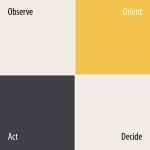
The Observe-Orient-Decide-Act loop shows that all decisions are based on observations of the evolving situation tempered with implicit filtering of the problem being addressed. It is about steering in, sometimes high, dynamics. The concept of OODA was developed by military strategist and United States Air Force Colonel John Boyd. He applied the concept to the combat operations process, often at the operational level during military campaigns. It is now also often applied to understand commercial operations and learning processes. The approach explains how agility can overcome raw power in dealing with human opponents.
Control and improvement
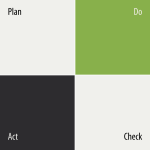
The Plan-Do-Check-Act loop is an iterative four-step management method used in business for the control and continual improvement of processes and products. The concept of PDCA is based on the scientific method. A fundamental principle here is iteration – once a hypothesis is confirmed (or negated), executing the cycle again will extend the knowledge further. Repeating the PDCA cycle can bring its users closer to the goal, usually a perfect operation and output.
Performance
Performance management is working in the cycle Plan-Develop-Perform-Review. It is an ongoing process of open communication in support of accomplishing the strategic objectives of the organisation, team or person. The communication process includes clarifying expectations, setting objectives, identifying goals, providing feedback, and reviewing results.
Publicfinance
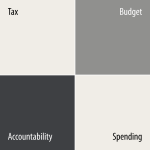
The cycle of public finance, that of Tax-Budget-Spending-Accountability in fact is a simple one, but one of the most crucial ones in present approach of major social and economical challenges. Government needs tax as its basis, decides how to budget their plans, products and services, then spend the money for production, implementation and delivery and at the take accountability for this to its voters, clients and citizens. It is a cycle, that repeats itself every year, on all levels of government.
Quality
The Common Assessment Framework (CAF) is about the connection of Leadership-Resource-Process-Result. It is use as the European quality management instrument for the public sector. It is there to assist its organisations to improve their performance. This quality framework helps the organisations to perform a self-assessment, to develop an improvement plan based on this and to implement the improvement actions. The model is based on the premise that excellent results in organisational performance, citizens/customers, people and society are achieved through leadership, driving strategy and planning, people, partnerships, resources and processes.
Strategy
One of the most heard and used terms in the public sector is the word strategy. In times of change it is considered as the model which shares light on the path towards the future. One of the cycles is Diagnosis-Course-Policy-Implementation. It is about the process of defining a new course, based on proper diagnosis and with the explicit purpose or at least intention to elaborate the course into policy (read: planning) and at the end implementation. Strategy can be considered as a cycle – as it has done here – but is often is used as stand-alone step on its own. The cycle has many variants, and depends on the school of philosophy.
_____
On location
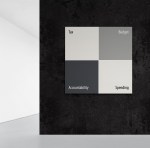
Every design is available for print. The models are designed in a consistent way, for a broad use and applicability in a wide range of dimensions, from postcard to ‘museum’ dimensions. Here you find a selection of the collection for gallery, hall, home, office, outdoor and public space. Showcasing them in rooms where clients or guests meet raises the awareness of the richness of concepts, thoughts and wisdoms.
A biome can be defined (Campbell, 1996) as” a major community on earth with a predominant vegetation and adapted organisms to that particular environment.” In fact the biomes of the present world can be considered as our major natural habitats. It is where biotic and abiotic elements of the ecosystems meet. It is in fact the place where biodiversity and resilience are made and engineered (by nature).
I designed – with the golden ratio in mind – these set of biomic landscapes. The Pantone® colours are hand-picked, corresponding with the biomes, for accurate colour management and print reproduction.
For home and office
The biomes are designed for a broad use and can be printed in a wide range of dimensions, from postcard to ‘museum’ dimensions. Here you fine a selection for the application for gallery, hall, home, office, outdoor and public space. Showcasing them in rooms where people meet, raises the awareness of the treasuries of Mother Earth.
In the office you can express and communicate your core philosophy and business approach with your clients and customers. You can make a true statement with your wall-art.
My motto: “A wisdom on the wall is a window to the world”. Knowing where you are, is the first step towards proper navigation. Note: The colours in the slides may differ from those of the actual prints. Every design is available as an open edition print.
Arctic biome
Coral reef (biome)
Desert biome
Forest biome
Freshwater biome
Grassland biome
Marine biome
Tundra biome
Arctic biome
The Arctic and Antarctic stretch out in the polar regions, consisting of frozen land and seas. It are unique area’s among Earth’s ecosystems, because of their cold and extreme conditions. Life includes organisms living in the ice, zooplankton and phytoplankton, fish and marine mammals, birds, land animals, plants and at the arctic also human societies. They belong to the arctic biome.
Coral reef (biome)
Coral reefs are in fact part of the marine biome, often called “rainforests of the sea”, and form some of Earth’s most diverse ecosystems. They occupy less than 0.1% of the world’s ocean area (half the area of France), yet provide a home for at least 25% of all marine species.
Desert biome
The desert is a region so arid because of little rainfall that it supports only sparse and widely spaced vegetation or no vegetation at all. It belongs to the desert biome.
Forest biome
This is a biological community that is dominated by trees and other woody vegetation. More than one half of tropical forests have already been destroyed. Only scattered remnants of original temperate forests remain. Current extensive logging in boreal forests may soon cause their disappearance. There are three major types of forests; tropical rainforest, temperate forest and boreal forest (taiga).
Freshwater biome
3% of earth’s water is freshwater and about 70% of that is sequestered in polar ice. There are wetlands inundated with water, streams and rivers with running water and ponds and lakes with accumulating water.
Grassland biome
Grasslands are characterized as lands dominated by grasses. Continental climate (hot and dry) is favourable for grasses rather than for large shrubs or trees. There are savannas, prairies and steppes.
Marine biome
The marine biome dominates the surface of the Earth, covering about three-quarters of the Earth’s surface area. The world’s oceans contain the richest diversity of species of any space on Earth. Rainwater for land areas is supplied by the evaporation of ocean waters. There are oceans, coral reefs, and estuaries.
Tundra biome
The tundra is characterized as lands with shrubby vegetation, composed of dwarf shrubs, sedges and grasses, mosses, and lichens, which is adapted to harsh conditions with an extremely cold climate. The biodiversity is low, there is poor nutrients availability and little precipitation with a short season (the Arctic summer) of growth and reproduction. There are alpine and arctic tundras.
Bibliography
Campbell, N. (1996) Biology 3th edn. California Menlo Park: The Benjamin/Cummings Publishing Company
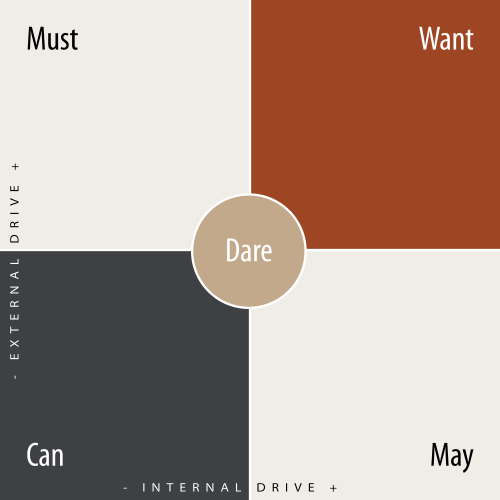
This matrix links the internal and external drive to that of the language domain. It is often used in communication within politics and government. Of course, it also applies to the private and business worlds and the personal domains. Our words often share a light behind the scenes. This diagram brings drives and words together.
The maximum of both worlds is want, and if the external drive is higher than the internal must is used, vice versa that is may. If both are low then can is used. In the middle of the matrix, the word dare is positioned to cross over or break through the boundaries of a quadrant. The matrix is often used in communication, co-creation and design sessions within groups.
The spoken language can tell us a lot about the internal drive of those who use the word in relation to the need to act. Many present policy plans use the word must. The context here is the need for change, innovation, development, transition, and transformation related to climate, energy, water, cyber, circular, social care, finance, resilience, and ecosystem protection. Migrating to want would give a lot of power. Is this possible, maybe seduction and education?
My word can be considered as an indicator of where I am in the diagram. From there, navigation can start.
Bibliography
Graaf, A. de en Kunst, K. (2009) Einstein en de kunst van het zeilen: Praktijkboek over leiderschap en communicatie. Amsterdam: Uitgeverij SWP. link